

Terminology
Hotspot
The word hotspot describes various skewed data access patterns in a , often manifesting as higher utilization on one or more . Hotspots can also result from , usage, or other finite resources in the cluster. Hotspots are performance issues that cannot be solved by , because they are typically limited to a fixed-size subset of the cluster’s resources.Hot node
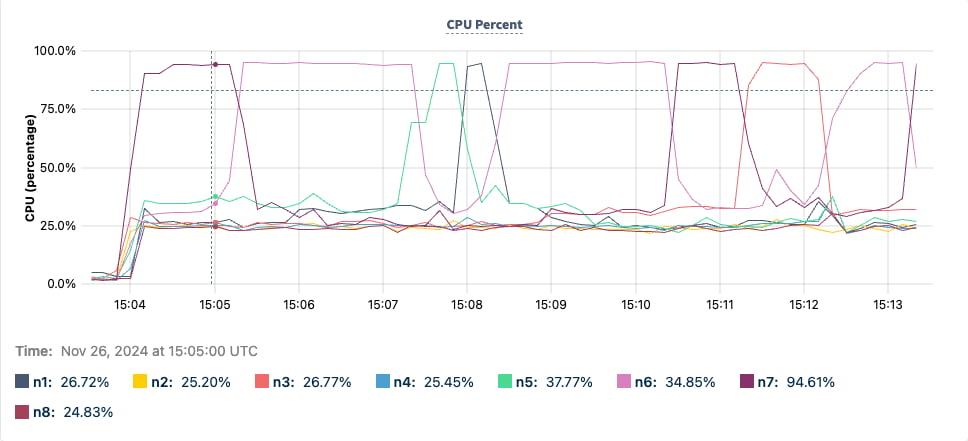
Synonyms: node hotspot A hot node is the most common indicator of a hotspot because the shows resource utilization per node by default. In distributed databases, like CockroachDB, identifying hot nodes or node hotspots is a key troubleshooting technique. Hot nodes typically exhibit:- Significantly higher utilization metrics compared to other nodes in the cluster.
- Noticeable outlier behavior in performance and resource consumption.
- A higher likelihood of occurring when the cluster is not operating at maximum capacity.
All hotspot types described on this page will create hot nodes, as long as the cluster is not already operating at maximum capacity.
Hot range
Synonyms: range hotspot A hot range is one level down from the node hotspot. are the smallest unit of data distribution, making them critical in troubleshooting hotspots. The provides details about ranges receiving a high number of reads or writes, which become an issue if they cause a hot node. A hot node is often caused by a single hot range. The system may split the hot range to redistribute the load () or the range may stay hot until it fills up and splits (). In the second case, the split is likely the continuation of the hotspot (as shown in the previous image for a hot node). If the system is unable to identify a good splitting point for a hot range (for example, in the case of a row hotspot), the hot range becomes a bottleneck. Understanding which range is hot and having knowledge of the allows you to approximate the type of hotspot compared to relying solely on node-level metrics.Moving hotspot
A moving hotspot describes a hotspot that moves consistently during its life, for example:- From one node to another within the cluster.
- Within a specific part of the keyspace, such as always reading the last 10 inserted rows on table T.
A queue-like workload pattern is not recommended in CockroachDB. However, if your use case requires this workload pattern, consider using .
Static hotspot
A static hotspot remains fixed in the keyspace, though it may move from node to node. The underlying cause of the hotspot, whether a or a key, remains unchanged.Read hotspot
Synonyms: hot by read A read hotspot is a hotspot caused by read throughput, either from a few queries reading a lot of data or many queries reading a little data. Read hotspots can result from many queries requesting the same information or accessing adjacent data. Hotspots usually involve either read-heavy or write-heavy traffic, usually not both at the same time.Write hotspot
Synonyms: hot by write A write hotspot is a hotspot caused by write throughput. Write hotspots increase the likelihood of within the hot node or hot range, therefore leading to potential performance issues. Write hotspots are unlike the other hotspots described on this page because they affect more than a single node. Since and must take place, write hotspots often affect multiple nodes based on the .Read/write pressure
Pressure describes how close system resources, such as disk I/O, CPU, memory, and even non-hardware resources like , are to their limits. It is especially useful when correlating pressure with activity, for example, the read pressure on Node 1 is coming from the key/User/10. Pressure effectively describes resource limits, encompassing , utilization, and throughput — all potential sources hotspots.
Index tail
Synonyms: index maximum present key An index tail is the largest existing key of an index, lexicographically. Note that this is different from the index (such as/Table/1/1) or index spans (such as [/Table/1/1, /Table/1/2)), because these are not valid row keys. An index tail instead refers to the last real key that appears in the index. For example, the head and tail of the index /Table/1/1 are: [/Table/1/1/aardvark, /Table/1/1/zultan].
Patterns
This section goes into detail about workload patterns that can result in hotspots.Index hotspot
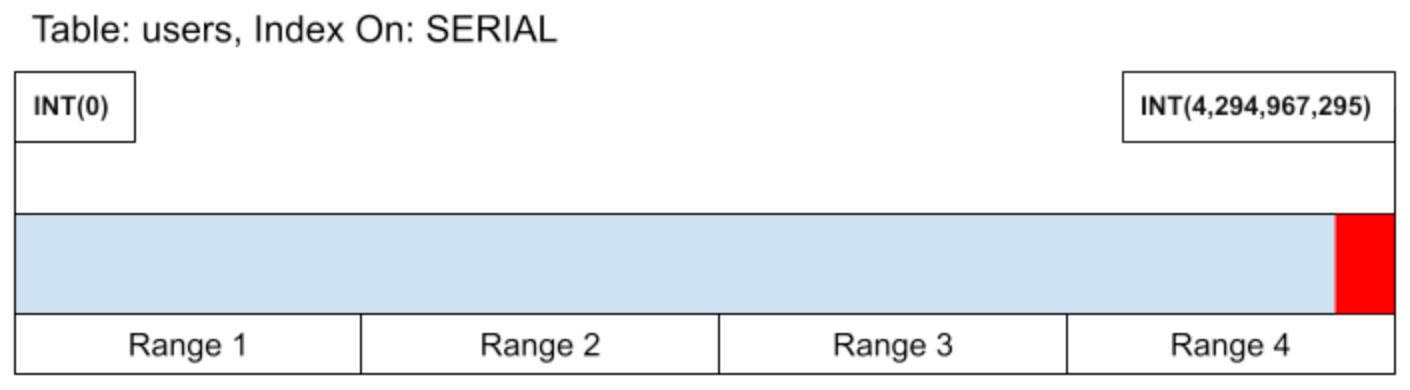
Synonyms: hot index, golden keyspace hotspot, monotonically increasing index, a running tail, a moving tail An index hotspot is a hotspot on an where the key for writes is continually increasing. This is common with indexing by an increasing column. For example, the column may be of data type , , or . However, an index hotspot is not always determined by the data type. If sequential data generated by the application is inserted into an index, a hotspot may occur. Index hotspots limit horizontal scaling as the index acts as a bottleneck. Consider a tableusers that contains a user_id, which is an incrementing integer value. Each new key will be the current maximum key + 1. In this way, all writes appear at the index tail. The following image visualizes writes to the users table using an incrementing INT primary key. Note how all writes are focused at the tail of the index, represented by the red section in Range 4.
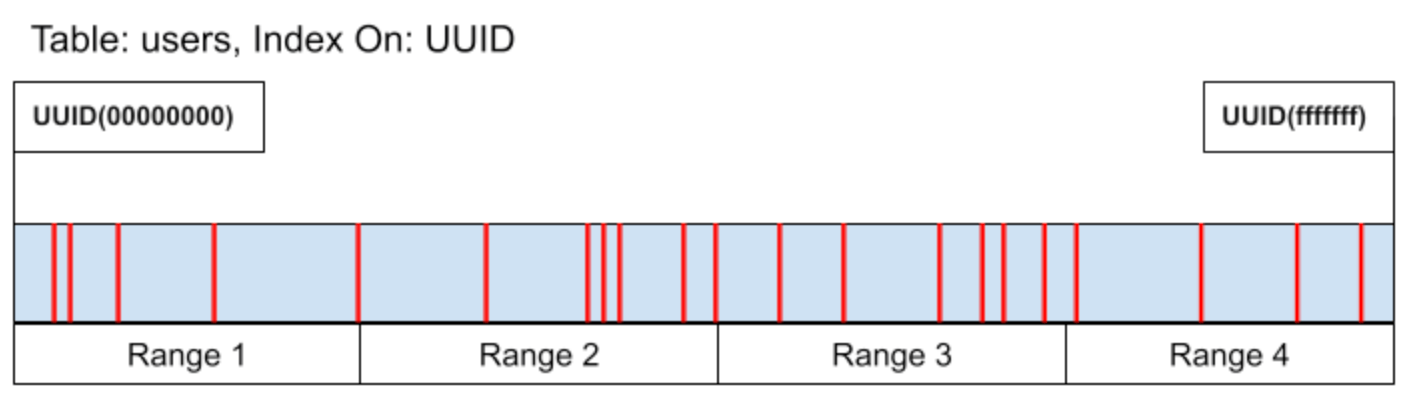
users that contains a primary key user_uuid of type . Because UUIDs are pseudo-random, new rows are inserted into the keyspace at random locations. The following image visualizes writes to the users table using a UUID primary key. Red lines indicate an insert into the keyspace. Note how the red lines are distributed evenly.
users that now has a on a TIMESTAMP column:
DESC with the same insertion strategy will cause a hotspot.
On this page, the phrase index hotspot will be reserved for a hot by write hotspot on an index, even though indexes can become hot due to read. This is because a hot by write index hotspot is the most common hotspot pattern that occurs now and in the future as workloads continue to be migrated from legacy single-node installations. Hot by read index hotspots are defined later on this page as lookback hotspots.
Resolving index hotspots
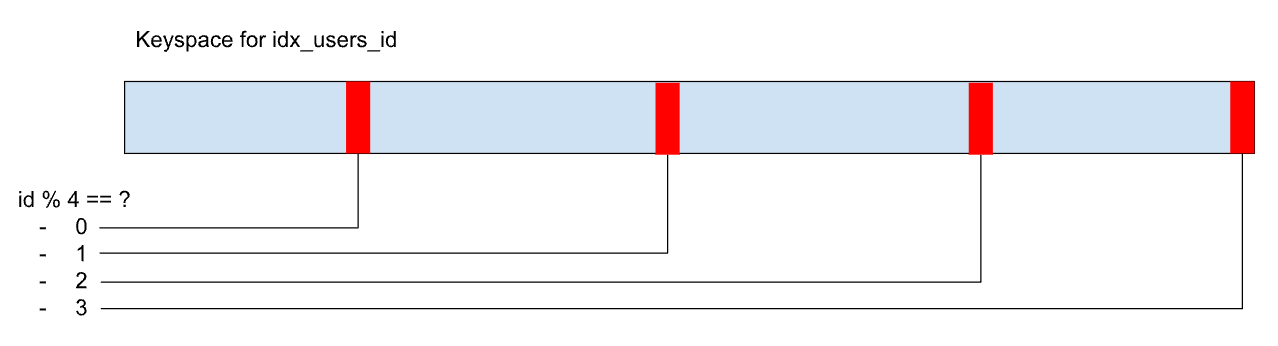
The resolution of the index hotspot often depends on your requirements for the data. If the sequential nature of the index serves no purpose, it is recommended to change the writes into the index to be randomly distributed. Ideally, primary keys in this instance would be set to s, if your tolerance for swapover or even downtime allows it. If inserting in sequential order is important, the index itself can be , which means that it is still stored in order, albeit in some number of shards. Consider ausers table, with a primary key id INT, which is hash-sharded with 4 shards, and a hashing function of modulo 4. The following image illustrates this example:
Paradoxical performance implicationsIndex hotspots paradoxically increase the efficiency of CockroachDB from the standpoint of the number of CPU cycles per write. This is primarily due to . As index hotspots continually move in a single direction, the files generated by them have little overlap. Consequently, this results in minimal write throughput compared to a properly distributed workload. However, this performance boost has a limit, and relying on hotspot behavior for this advantage is problematic because hotspots can cause other issues.
Lookback hotspots
Synonyms: index scan hotspot, moving read hotspot A lookback hotspot is a type of index hotspot in which a moving subset of an index is being read in a way that burdens the cluster. For example, consider querying aposts table for the most recently created post:
Queueing hotspot
Synonyms: outbox hotspot A queueing hotspot is a type of index hotspot that occurs when a workload treats CockroachDB like a distributed queue. This can happen if you implement the . Queues, such as logs, generally require data to be ordered by write, which necessitates indexing in a way that is likely to create a hotspot. An outbox where data is deleted as it is read has an additional problem: it tends to accumulate an ordered set of behind the live data. Since the system cannot determine whether any live rows exist within the garbage data, what appears to be a small table scan to the user can actually result in an unexpectedly intensive scan on the garbage data.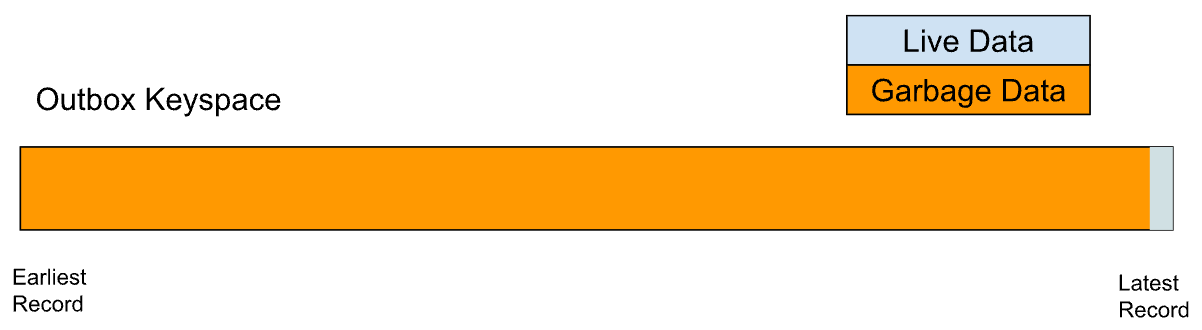
Row hotspot
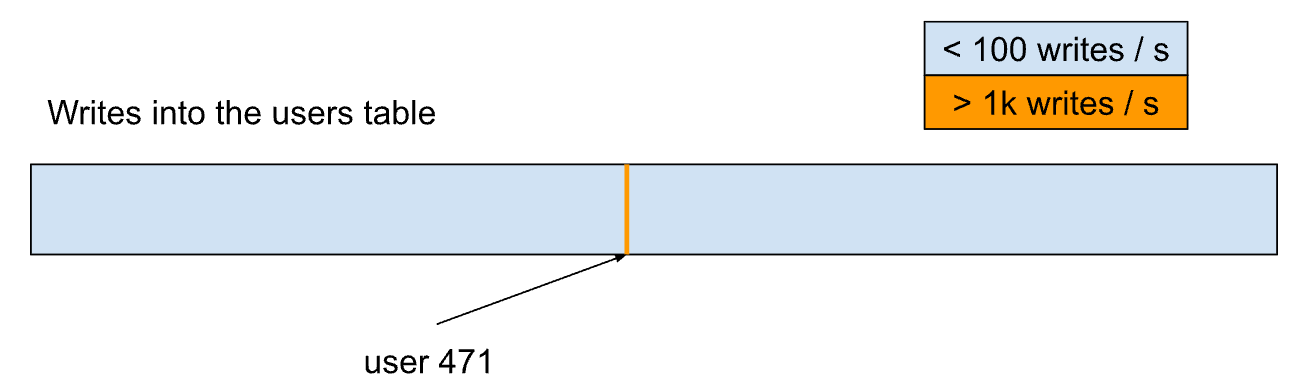
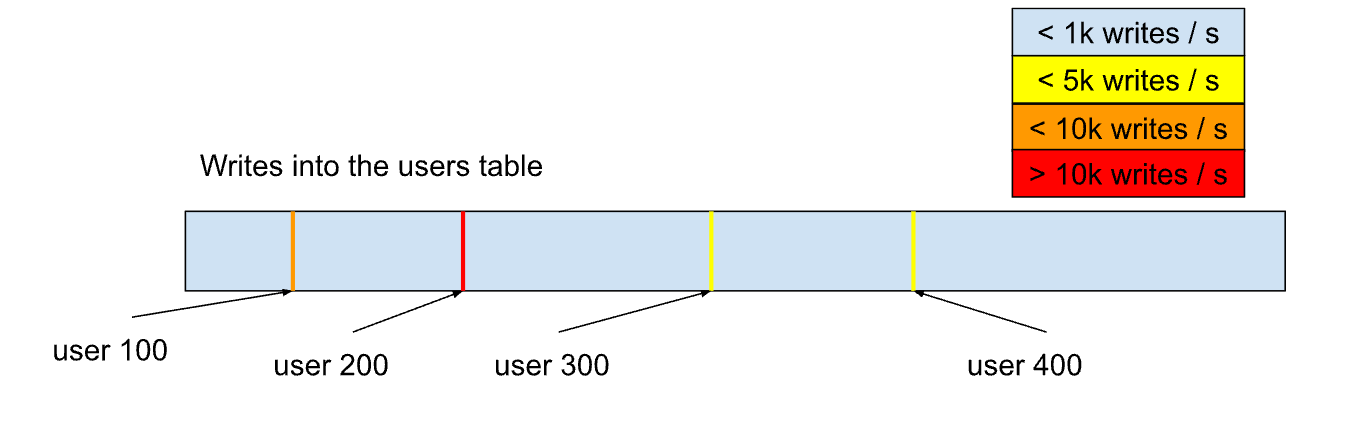
Synonyms: hot key, hot row, point hotspot A row hotspot is a hotspot where an individual point in the keyspace becomes throughput limiting, often due to high activity on a single row. Since rows are inherently indivisible, a hotspot on a row cannot be . A classic example is a social media application with a high volume of activity on certain users. Consider a social media application that initially consists of two tables,users and follows:
follows table each time you want to know the count of followers for a given user, you can issue an UPDATE to the users table to increment the follower_count. This way, every time a new follower is added, the follower_count in the users table is updated directly, making it easier and faster to retrieve the follower_count without scanning the entire follows table:
Hot sequence
Hot sequences and hot indexes are distinct concepts, though they may appear similar at a glance, since a hot index often involves a . However, they have different bottlenecks. For example, consider the following schema:products keyspace using hash-sharded rows. With five shards, the writes are better distributed into the keyspace, but the id sequence row becomes the limiting factor.
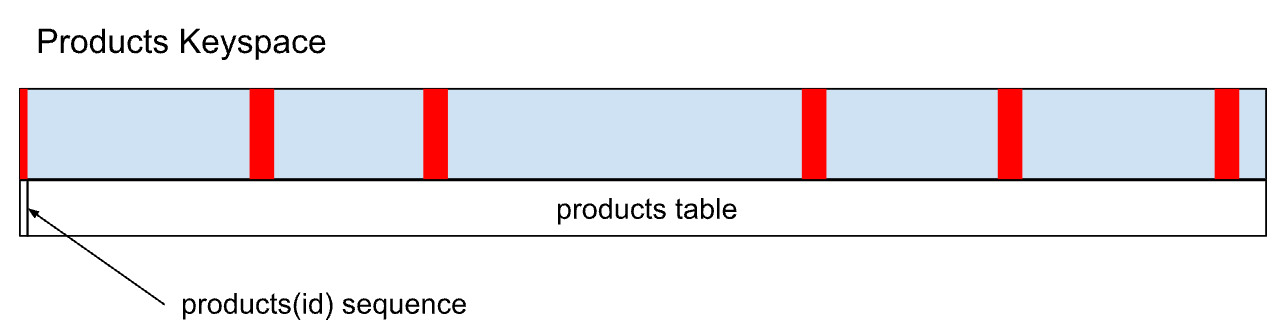
unique_rowid() function generates sequential values which have strong guarantees against collision, with the drawback that its values are not a series.
Table hotspot
Synonyms: hot table Hot tables are another variant of hot keys. Instead of a few select keys being burdened, the majority of the table is burdened by read (and at times write) access. This generally occurs on small reference tables that are used in queries with a . This can lead to uneven key access. Consider the following example that joins a small reference tablecountries into a larger distributed table posts.
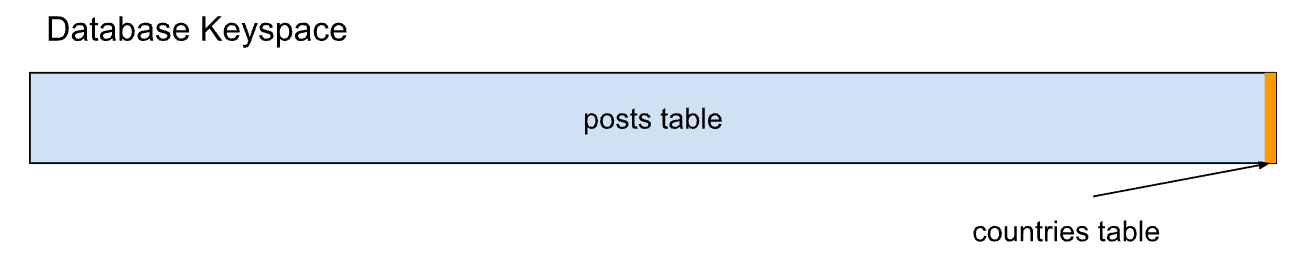
posts table may be evenly distributed, but joining the countries table becomes a bottleneck, since it exists in so few ranges. Splitting the countries table ranges can relieve pressure, but only to a limit as the indivisible rows experience high throughput. and can help scaling in this case, especially when write throughput is low.
Locality hotspot
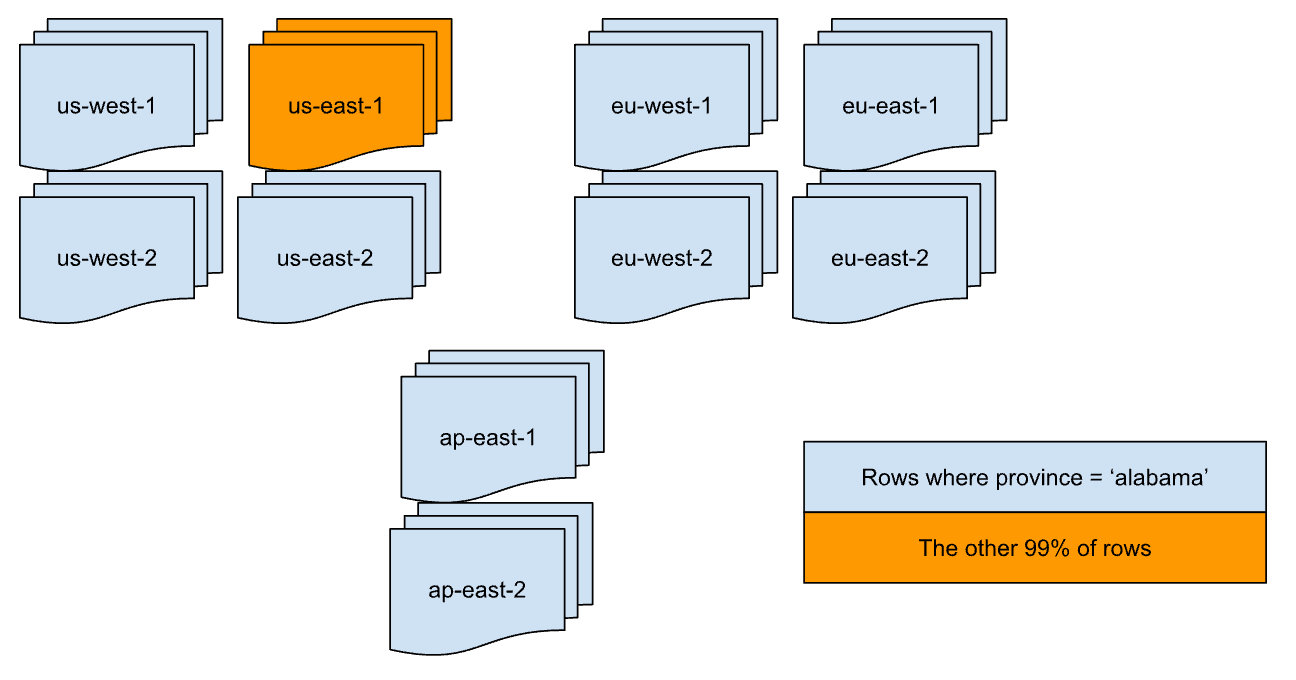
Synonyms: region hotspot, domicile hotspot A locality hotspot is a hotspot where a workload is bottlenecked due to . For example, consider a cluster distributed among 10 regions (e.g.,us-east-1, us-west-1, ap-east-1, eu-west-1, etc.) with 5 nodes per region. Assume this 50 node cluster is for an existing application and you wish to domicile the data on the highest throughput table, orders, by the region most relevant to where an order is placed.
ALTER statement, the first condition province <> 'alabama' checks whether the province is not alabama. It matches every single row in the table that is not alabama, and will place them in the us-east-1 region.
By doing this, you have limited the traffic from the highest throughput table to a single region, five nodes or 10% of the nodes in your cluster.
The following image visualizes the regional breakout of data in the orders table. Because of the domiciling policy, reads and writes to the orders table will be focused on the us-east-1 nodes.
Temporal hotspot
Synonyms: time-based hotspot Temporal hotspots refer to increased database usage during particular windows of time. These take a variety of shapes, from event and holiday usage, to synchronized job runs.Load balancing hotspot
A load balancing hotspot is a hotspot caused by a misconfiguration. This means that the connections are not distributed equally across all nodes. Instead, one node receives an excessive number of connections, resulting in an overload. Although this issue is often considered an afterthought because key hotspots are generally more common, it is important to note that all possible consumer groups can create uneven load on the cluster. For example, a subscription can create hotspots if a single node is responsible for exporting all row updates within the cluster.Tenant hotspot
Synonyms: noisy neighbor, ghost hotspot A tenant hotspot is a hotspot where one tenant’s workload affects another tenant’s performance. This occurs when a hotspot on one tenant’s data causes degradation in nodes where another tenant’s data is colocated. For example, consider a cluster with tenants A and B. Tenant A’s workload generates a hotspot. Tenant B’s tables experience degradation on nodes where their data is colocated with Tenant A’s hotspot. In this case, we say that Tenant B is experiencing a tenant hotspot.Reduce hotspots
- Use index keys with a random distribution of values, so that transactions over different rows are more likely to operate on separate data ranges. See the on row IDs for suggestions.
-
Place parts of the records that are modified by different transactions in different tables. That is, increase normalization. However, there are benefits and drawbacks to increasing normalization.
-
Benefits of increasing normalization:
- Can improve performance for write-heavy workloads. This is because, with increased normalization, a given business fact must be written to one place rather than to multiple places.
- Allows separate transactions to modify related underlying data without causing .
- Reduces the chance of data inconsistency, since a given business fact must be written only to one place.
- Reduces or eliminates data redundancy.
- Uses less disk space.
-
Drawbacks of increasing normalization:
- Can reduce performance for read-heavy workloads. This is because increasing normalization results in more joins, and can make the SQL more complicated in other ways.
- More complex data model.
-
In general:
- Increase normalization for write-intensive and read/write-intensive transactional workloads.
- Do not increase normalization for read-intensive reporting workloads.
-
Benefits of increasing normalization:
- If the application strictly requires operating on very few different index keys, consider using so that each index key can be served by a separate group of nodes in the cluster.
- If you are working with a table that must be indexed on sequential keys, consider using . For details about the mechanics and performance improvements of hash-sharded indexes in CockroachDB, see the blog post Hash Sharded Indexes Unlock Linear Scaling for Sequential Workloads. As part of this, we recommend doing thorough performance testing with and without hash-sharded indexes to see which works best for your application.
-
To avoid read hotspots:
- Increase data distribution, which will allow for more ranges. The hotspot exists because the data being accessed is all co-located in one range.
-
Increase across more nodes in the same range. Most transactional reads must go to the leaseholder in CockroachDB, which means that opportunities for load balancing over replicas are minimal.
However, the following features do permit load balancing over replicas:
- .
- (both the bounded staleness and the exact staleness kinds).