> ## Documentation Index
> Fetch the complete documentation index at: https://cockroachlabs.mintlify.site/llms.txt
> Use this file to discover all available pages before exploring further.
# Changefeed Messages
export const InternalLink = ({version, path = "", children, ...props}) => {
let detectedVersion = version || "stable";
if (typeof window !== 'undefined' && !version) {
const match = window.location.pathname.match(/\/docs\/([^/]+)/);
if (match) {
detectedVersion = match[1];
}
}
const normalizedPath = path.startsWith("/") ? path.slice(1) : path;
return
{children}
;
};
Changefeeds generate and emit messages (on a per-key basis) as changes happen to the rows in watched tables. CockroachDB changefeeds have an at-least-once delivery guarantee as well as message ordering guarantees. You can also configure the format of changefeed messages with different options (e.g., `format=avro`).
This page describes the format and behavior of changefeed messages. You will find the following information on this page:
* [Responses](#responses): The general format of changefeed messages.
* [Message envelopes](#message-envelopes): The structure of the changefeed message.
* [Ordering and delivery guarantees](#ordering-and-delivery-guarantees): CockroachDB's guarantees for a changefeed's message ordering and delivery.
* [Delete messages](#delete-messages): The format of messages when a row is deleted.
* [Resolved messages](#resolved-messages): The resolved timestamp option and how to configure it.
* [Duplicate messages](#duplicate-messages): The causes of duplicate messages from a changefeed.
* [Schema changes](#schema-changes): The effect of schema changes on a changefeed.
* [Filtering changefeed messages](#filtering-changefeed-messages): The settings and syntax to prevent and filter the messages that changefeeds emit.
* [Message formats](#message-formats): The limitations and type mapping when creating a changefeed with different message formats.
Changefeed types are not fully integrated with user-defined composite types. Running changefeeds with user-defined composite types is in Preview. Certain changefeed types do not support user-defined composite types. Refer to the change data capture Known Limitations for more detail.
## Responses
By default, changefeed messages emitted to a sink contain keys and values of the watched table rows that have changed. The message will contain the following fields depending on the type of emitted change and the options you specified to create the changefeed:
* **Key**: An array composed of the row's `PRIMARY KEY` field(s) (e.g., `[1]` for JSON or `{"id":{"long":1}}` for Avro).
* **Value**:
* One of four possible top-level fields:
* `after`, which contains the state of the row after the update (or `null` for `DELETE`s).
* `updated`, which contains the updated timestamp.
* `resolved`, which is emitted for records representing [resolved](#resolved-messages) timestamps. These records do not include an `after` value since they only function as checkpoints.
* `before`, which contains the state of the row before an update. Changefeeds must use the `diff` option with the default [`wrapped` envelope](#wrapped) to emit the `before` field. When a row did not previously have any data, the `before` field will emit `null`.
* For `INSERT` and `UPDATE`, the current state of the row inserted or updated.
* For `DELETE`, `null`.
If you use the `envelope` option to alter the changefeed message fields, your messages may not contain one or more of the values noted in the preceding list. As an example, when emitting to a Kafka sink, you can limit messages to just the changed key value by using the `envelope` option set to [`key_only`](#key_only). For more detail, refer to [Message envelopes](#message-envelopes).
For example, changefeeds emitting to a sink will have the default message format:
| Statement | Response |
| ---------------------------------------------- | ------------------------------------------------------------------------------------------------------------------------------------------------------- |
| `INSERT INTO office_dogs VALUES (1, 'Petee');` | JSON: `[1] {"after": {"id": 1, "name": "Petee"}}` \Avro: `{"id":{"long":1}} {"after":{"office_dogs":{"id":{"long":1},"name":{"string":"Petee"}}}}` |
| `DELETE FROM office_dogs WHERE name = 'Petee'` | JSON: `[1] {"after": null}` \Avro: `{"id":{"long":1}} {"after":null}` |
When a changefeed targets a table with multiple column families, the family name is appended to the table name as part of the topic. Refer to Tables with columns families in changefeeds for guidance.
For webhook sinks, the response format arrives as a batch of changefeed messages with a `payload` and `length`.
```
{"payload": [{"after" : {"a" : 1, "b" : "a"}, "key": [1], "topic": "foo"}, {"after": {"a": 1, "b": "b"}, "key": [1], "topic": "foo" }], "length":2}
```
Webhook message batching is subject to the same key [ordering guarantee](#ordering-and-delivery-guarantees) as other sinks. Therefore, as messages are batched, you will not receive two batches at the same time with overlapping keys. You may receive a single batch containing multiple messages about one key, because ordering is maintained for a single key within its batch.
Refer to changefeed files for more detail on the file naming format for changefeeds that emit to a sink.
## Message envelopes
The *envelope* defines the structure of a changefeed message. You can use the `envelope` option to manipulate the changefeed envelope. The values that the `envelope` option accepts are compatible with different changefeed sinks, and the structure of the message will vary depending on the sink.
Changefeeds created with `EXPERIMENTAL CHANGEFEED FOR` or `CREATE CHANGEFEED` with no sink specified (sinkless changefeeds) produce messages without the envelope metadata fields of changefeeds emitting to sinks.
The following sections provide examples of changefeed messages that are emitted when you specify each of the supported `envelope` options. Other changefeed options can affect the message envelope and what messages are emitted. Therefore, the examples are a guide for what you can expect when only the `envelope` option is specified.
### `wrapped`
`wrapped` is the default envelope structure for changefeed messages. This envelope contains an array of the primary key (or the key as part of the message metadata), a top-level field for the type of message, and the current state of the row (or `null` for [deleted rows](#delete-messages)).
The message envelope contains a primary key array when your changefeed is emitting to a sink that does not have a message key as part of its protocol, (e.g., cloud storage, webhook sinks, or Google Pub/Sub). By default, messages emitted to Kafka sinks do not have the primary key array, because the key is part of the message metadata. If you would like messages emitted to Kafka sinks to contain a primary key array, you can use the `key_in_value` option. Refer to the following message outputs for examples of this.
* Cloud storage sink:
```sql theme={"theme":{"light":"catppuccin-mocha","dark":"catppuccin-mocha"}}
CREATE CHANGEFEED FOR TABLE vehicles INTO 'external://cloud';
```
```
{"after": {"city": "seattle", "creation_time": "2019-01-02T03:04:05", "current_location": "86359 Jeffrey Ranch", "ext": {"color": "yellow"}, "id": "68ee1f95-3137-48e2-8ce3-34ac2d18c7c8", "owner_id": "570a3d70-a3d7-4c00-8000-000000000011", "status": "in_use", "type": "scooter"}, "key": ["seattle", "68ee1f95-3137-48e2-8ce3-34ac2d18c7c8"]}
```
* Kafka sink:
* Default when `envelope=wrapped` or `envelope` is not specified:
```sql theme={"theme":{"light":"catppuccin-mocha","dark":"catppuccin-mocha"}}
CREATE CHANGEFEED FOR TABLE vehicles INTO 'external://kafka';
```
```
{"after": {"city": "washington dc", "creation_time": "2019-01-02T03:04:05", "current_location": "24315 Elizabeth Mountains", "ext": {"color": "yellow"}, "id": "dadc1c0b-30f0-4c8b-bd16-046c8612bbea", "owner_id": "034075b6-5380-4996-a267-5a129781f4d3", "status": "in_use", "type": "scooter"}}
```
* Kafka sink message with `key_in_value` provided:
```sql theme={"theme":{"light":"catppuccin-mocha","dark":"catppuccin-mocha"}}
CREATE CHANGEFEED FOR TABLE vehicles INTO 'external://kafka' WITH key_in_value, envelope=wrapped;
```
```
{"after": {"city": "washington dc", "creation_time": "2019-01-02T03:04:05", "current_location": "46227 Jeremy Haven Suite 92", "ext": {"brand": "Schwinn", "color": "red"}, "id": "298cc7a0-de6b-4659-ae57-eaa2de9d99c3", "owner_id": "beda1202-63f7-41d2-aa35-ee3a835679d1", "status": "in_use", "type": "bike"}, "key": ["washington dc", "298cc7a0-de6b-4659-ae57-eaa2de9d99c3"]}
```
#### `wrapped` and `diff`
To include a `before` field in the changefeed message that contains the state of a row before an update in the changefeed message, use the `diff` option with `wrapped`:
```sql theme={"theme":{"light":"catppuccin-mocha","dark":"catppuccin-mocha"}}
CREATE CHANGEFEED FOR TABLE rides INTO 'external://kafka' WITH diff, envelope=wrapped;
```
```
{"after": {"city": "seattle", "end_address": null, "end_time": null, "id": "f6c02fe0-a4e0-476d-a3b7-91934d15dce2", "revenue": 25.00, "rider_id": "14067022-6e9b-427b-bd74-5ef48e93da1f", "start_address": "2 Michael Field", "start_time": "2023-06-02T15:14:20.790155", "vehicle_city": "seattle", "vehicle_id": "55555555-5555-4400-8000-000000000005"}, "before": {"city": "seattle", "end_address": null, "end_time": null, "id": "f6c02fe0-a4e0-476d-a3b7-91934d15dce2", "revenue": 25.00, "rider_id": "14067022-6e9b-427b-bd74-5ef48e93da1f", "start_address": "5 Michael Field", "start_time": "2023-06-02T15:14:20.790155", "vehicle_city": "seattle", "vehicle_id": "55555555-5555-4400-8000-000000000005"}, "key": ["seattle", "f6c02fe0-a4e0-476d-a3b7-91934d15dce2"]}
```
### `bare`
`bare` removes the `after` key from the changefeed message and stores any metadata in a `crdb` field. When used with `avro` format, `record` will replace the `after` key.
* Cloud storage sink:
```sql theme={"theme":{"light":"catppuccin-mocha","dark":"catppuccin-mocha"}}
CREATE CHANGEFEED FOR TABLE vehicles INTO 'external://cloud' WITH envelope=bare;
```
```
{"__crdb__": {"key": ["washington dc", "cd48e501-e86d-4019-9923-2fc9a964b264"]}, "city": "washington dc", "creation_time": "2019-01-02T03:04:05", "current_location": "87247 Diane Park", "ext": {"brand": "Fuji", "color": "yellow"}, "id": "cd48e501-e86d-4019-9923-2fc9a964b264", "owner_id": "a616ce61-ade4-43d2-9aab-0e3b24a9aa9a", "status": "available", "type": "bike"}
```
CDC queriesCDC queries use `envelope=bare` message format by default. The `bare` message envelope places the output of the `SELECT` clause at the top level of the message instead of under an `"after"` key. When there is additional information that the changefeed is sending, such as `updated` or `resolved` timestamps, the messages will include a `crdb` field containing this information.
* In CDC queries:
* A changefeed containing a `SELECT` clause without any additional options:
```sql theme={"theme":{"light":"catppuccin-mocha","dark":"catppuccin-mocha"}}
CREATE CHANGEFEED INTO 'external://kafka' AS SELECT city, type FROM movr.vehicles;
```
```
{"city": "los angeles", "type": "skateboard"}
```
* A changefeed containing a `SELECT` clause with the `topic_in_value` option specified:
```sql theme={"theme":{"light":"catppuccin-mocha","dark":"catppuccin-mocha"}}
CREATE CHANGEFEED INTO 'external://kafka' WITH topic_in_value AS SELECT city, type FROM movr.vehicles;
```
```
{"__crdb__": {"topic": "vehicles"}, "city": "los angeles", "type": "skateboard"}
```
### `key_only`
`key_only` emits only the key and no value, which is faster if you only need to know the key of the changed row. This envelope option is only supported for Kafka sinks or sinkless changefeeds.
* Kafka sink:
```sql theme={"theme":{"light":"catppuccin-mocha","dark":"catppuccin-mocha"}}
CREATE CHANGEFEED FOR TABLE users INTO 'external://kafka' WITH envelope=key_only;
```
```
["boston", "22222222-2222-4200-8000-000000000002"]
```
It is necessary to set up a [Kafka consumer](https://docs.confluent.io/platform/current/clients/consumer.html) to display the key because the key is part of the metadata in Kafka messages, rather than in its own field. When you start a Kafka consumer, you can use `--property print.key=true` to have the key print in the changefeed message.
* Sinkless changefeeds:
```sql theme={"theme":{"light":"catppuccin-mocha","dark":"catppuccin-mocha"}}
CREATE CHANGEFEED FOR TABLE users WITH envelope=key_only;
```
```
{"key":"[\"seattle\", \"fff726cc-13b3-475f-ad92-a21cafee5d3f\"]","table":"users","value":""}
```
### `row`
`row` emits the row without any additional metadata fields in the message. This envelope option is only supported for Kafka sinks or sinkless changefeeds. `row` does not support `avro` format—if you are using `avro`, refer to the [`bare`](#bare) envelope option.
* Kafka sink:
```sql theme={"theme":{"light":"catppuccin-mocha","dark":"catppuccin-mocha"}}
CREATE CHANGEFEED FOR TABLE vehicles INTO 'external://kafka' WITH envelope=row;
```
```
{"city": "washington dc", "creation_time": "2019-01-02T03:04:05", "current_location": "85551 Moore Mountains Apt. 47", "ext": {"color": "red"}, "id": "d3b37607-1e9f-4e25-b772-efb9374b08e3", "owner_id": "4f26b516-f13f-4136-83e1-2ea1ae151c20", "status": "available", "type": "skateboard"}
```
## Ordering and delivery guarantees
Changefeeds provide the following guarantees for message delivery to changefeed sinks:
* [Per-key ordering](#per-key-ordering) for the first emission of an event's message.
* [At-least-once delivery](#at-least-once-delivery) per event message.
Changefeeds do not support total message ordering or transactional ordering of messages.
### Per-key ordering
Changefeeds provide a *per-key ordering guarantee* for the **first emission** of a message to the sink. Once the changefeed has emitted a row with a timestamp, the changefeed will not emit any previously unseen versions of that row with a lower timestamp. Therefore, you will never receive a new change for that row at an earlier timestamp.
For example, a changefeed can emit updates to rows `A` at timestamp `T1`, `B` at `T2`, and `C` at `T3` in any order.
When there are updates to rows `A` at `T1`, `B` at `T2`, and `A` at `T3`, the changefeed will always emit `A` at `T3` (for the first time) **after** emitting `A` at `T1` (for the first time). However, `A` at `T3` could precede or follow `B` at `T2`, because there is no timestamp ordering between keys.
Under some circumstances, a changefeed will emit [duplicate messages](#duplicate-messages) of row updates. Changefeeds can emit duplicate messages in any order.
As an example, you run the following sequence of SQL statements to create a changefeed:
1. Create a table:
```sql theme={"theme":{"light":"catppuccin-mocha","dark":"catppuccin-mocha"}}
CREATE TABLE employees (
id INT PRIMARY KEY,
name STRING,
office STRING
);
```
2. Create a changefeed targeting the `employees` table:
```sql theme={"theme":{"light":"catppuccin-mocha","dark":"catppuccin-mocha"}}
CREATE CHANGEFEED FOR TABLE employees INTO 'external://sink' WITH updated;
```
3. Insert and update values in `employees`:
```sql theme={"theme":{"light":"catppuccin-mocha","dark":"catppuccin-mocha"}}
INSERT INTO employees VALUES (1, 'Terry', 'new york city');
INSERT INTO employees VALUES (2, 'Alex', 'los angeles');
UPDATE employees SET name = 'Terri' WHERE id = 1;
INSERT INTO employees VALUES (3, 'Ash', 'london');
UPDATE employees SET name = 'Terrence' WHERE id = 1;
UPDATE employees SET office = 'new york city' WHERE id = 2;
INSERT INTO employees VALUES (4, 'Danny', 'los angeles');
INSERT INTO employees VALUES (5, 'Robbie', 'london');
```
In a transaction, if a row is modified more than once in the same transaction, the changefeed will only emit the last change.
1. The sink will receive messages of the inserted rows emitted per timestamp:
```
{"after": {"id": 1, "name": "Terry", "office": "new york city"}, "key": [1], "updated": "1701102296662969433.0000000000"}
{"after": {"id": 1, "name": "Terri", "office": "new york city"}, "key": [1], "updated": "1701102311425045162.0000000000"}
{"after": {"id": 2, "name": "Alex", "office": "los angeles"}, "key": [2], "updated": "1701102305519323705.0000000000"}
{"after": {"id": 3, "name": "Ash", "office": "london"}, "key": [3], "updated": "1701102316388801052.0000000000"}
{"after": {"id": 1, "name": "Terrence", "office": "new york city"}, "key": [1], "updated": "1701102320607990564.0000000000"}
{"after": {"id": 2, "name": "Alex", "office": "new york city"}, "key": [2], "updated": "1701102325724272373.0000000000"}
{"after": {"id": 5, "name": "Robbie", "office": "london"}, "key": [5], "updated": "1701102330377135318.0000000000"}
{"after": {"id": 4, "name": "Danny", "office": "los angeles"}, "key": [4], "updated": "1701102561022789676.0000000000"}
```
The messages received at the sink are in order by timestamp **for each key**. Here, the update for key `[1]` is emitted before the insertion of key `[2]` even though the timestamp for the update to key `[1]` is higher. That is, if you follow the sequence of updates for a particular key at the sink, they will be in the correct timestamp order. However, if a changefeed starts to re-emit messages after the last checkpoint, it may not emit all duplicate messages between the first duplicate message and new updates to the table. For details on when changefeeds might re-emit messages, refer to [Duplicate messages](#duplicate-messages).
The `updated` option adds an `updated` timestamp to each emitted row. You can also use the [`resolved` option](#resolved-messages) to emit a `resolved` timestamp message to each Kafka partition, or to a separate file at a cloud storage sink. A `resolved` timestamp guarantees that no (previously unseen) rows with a lower update timestamp will be emitted on that partition.
Depending on the workload, you can use resolved timestamp notifications on every Kafka partition to provide strong ordering and global consistency guarantees by buffering records in between timestamp closures. Use the `resolved` timestamp to see every row that changed at a certain time.
#### Define a key column
Typically, changefeeds that emit to Kafka sinks shard rows between Kafka partitions using the row's primary key, which is hashed. The resulting hash remains the same and ensures a row will always emit to the same Kafka partition.
In some cases, you may want to specify another column in a table as the key by using the `key_column` option, which will determine the partition your messages will emit to. However, if you implement `key_column` with a changefeed, consider that other columns may have arbitrary values that change. As a result, the same row (i.e., by primary key) may emit to any partition at the sink based upon the column value. A changefeed with a `key_column` specified will still maintain per-key and at-least-once delivery guarantees.
To confirm that messages may emit the same row to different partitions when an arbitrary column is used, you must include the `unordered` option:
```sql theme={"theme":{"light":"catppuccin-mocha","dark":"catppuccin-mocha"}}
CREATE CHANGEFEED FOR TABLE employees INTO 'external://kafka-sink'
WITH key_column='office', unordered;
```
### At-least-once delivery
Changefeeds also provide an *at-least-once delivery guarantee*, which means that each version of a row will be emitted once. Under some infrequent conditions a changefeed will emit duplicate messages. This happens when the changefeed was not able to emit all messages before reaching a checkpoint. As a result, it may re-emit some or all of the messages starting from the previous checkpoint to ensure that every message is delivered at least once, which could lead to some messages being delivered more than once.
Refer to [Duplicate messages](#duplicate-messages) for causes of messages repeating at the sink.
For example, the checkpoints and changefeed pauses marked in this output show how messages may be duplicated, but always delivered:
```
{"after": {"id": 1, "name": "Terry", "office": "new york city"}, "key": [1], "updated": "1701102296662969433.0000000000"}
{"after": {"id": 1, "name": "Terri", "office": "new york city"}, "key": [1], "updated": "1701102311425045162.0000000000"}
{"after": {"id": 2, "name": "Alex", "office": "los angeles"}, "key": [2], "updated": "1701102305519323705.0000000000"}
[checkpoint]
{"after": {"id": 3, "name": "Ash", "office": "london"}, "key": [3], "updated": "1701102316388801052.0000000000"}
{"after": {"id": 1, "name": "Terrence", "office": "new york city"}, "key": [1], "updated": "1701102320607990564.0000000000"}
[changefeed pauses before the next checkpoint was reached]
[changefeed resumes and re-emits the messages after the previous checkpoint to ensure the sink received the messages]
{"after": {"id": 3, "name": "Ash", "office": "london"}, "key": [3], "updated": "1701102316388801052.0000000000"}
{"after": {"id": 1, "name": "Terrence", "office": "new york city"}, "key": [1], "updated": "1701102320607990564.0000000000"}
{"after": {"id": 2, "name": "Alex", "office": "new york city"}, "key": [2], "updated": "1701102325724272373.0000000000"}
[changefeed continues to emit new events]
{"after": {"id": 5, "name": "Robbie", "office": "london"}, "key": [5], "updated": "1701102330377135318.0000000000"}
{"after": {"id": 4, "name": "Danny", "office": "los angeles"}, "key": [4], "updated": "1701102561022789676.0000000000"}
[checkpoint]
```
In this example, with duplicates removed, an individual row is emitted in the same order as the transactions that updated it. However, this is not true for updates to two different rows, even two rows in the same table. (Refer to [Per-key ordering](#per-key-ordering).)
The first time a message is delivered, it will be in the correct timestamp order, which follows the [per-key ordering guarantee](#per-key-ordering). However, when there are [duplicate messages](#duplicate-messages), the changefeed may **not** re-emit every row update. As a result, there may be gaps in a sequence of duplicate messages for a key.
To compare two different rows for [happens-before](https://wikipedia.org/wiki/Happened-before), compare the `updated` timestamp. This works across anything in the same cluster (tables, nodes, etc.).
The complexity with timestamps is necessary because CockroachDB supports transactions that can affect any part of the cluster, and it is not possible to horizontally divide the transaction log into independent changefeeds. For more information about this, [read our blog post on CDC](https://www.cockroachlabs.com/blog/change-data-capture/).
When changes happen to a column that is part of a composite key, the changefeed will produce a [delete message](#filter-delete-messages) delete message and then an insert message.
## Delete messages
Deleting a row will result in a changefeed outputting the primary key of the deleted row and a null value. For example, with default options, deleting the row with primary key `5` will output:
```json theme={"theme":{"light":"catppuccin-mocha","dark":"catppuccin-mocha"}}
[5] {"after": null}
```
In some unusual situations you may receive a delete message for a row without first seeing an insert message. For example, if an attempt is made to delete a row that does not exist, you may or may not get a delete message because the changefeed behavior is undefined to allow for optimizations at the storage layer. Similarly, if there are multiple writes to a row within a single transaction, only the last one will propagate to a changefeed. This means that creating and deleting a row within the same transaction will never result in an insert message, but may result in a delete message.
## Resolved messages
When you create a changefeed with the `resolved` option, the changefeed will emit resolved timestamp messages in a format dependent on the connected sink. The resolved timestamp is the high-water mark that guarantees that no previously unseen rows with an [earlier update timestamp](#ordering-and-delivery-guarantees) will be emitted to the sink. That is, resolved timestamp messages do not emit until the changefeed job has reached a checkpoint.
When you specify the `resolved` option at changefeed creation, the job's coordinating node will send the resolved timestamp to each endpoint at the sink. For example, each Kafka partition will receive a resolved timestamp message, or a cloud storage sink will receive a resolved timestamp file.
There are three different ways to configure resolved timestamp messages:
* If you do not specify the `resolved` option at all, then the changefeed coordinator node will not send resolved timestamp messages.
* If you include `WITH resolved` in your changefeed creation statement **without** specifying a value, the coordinator node will emit resolved timestamps as the changefeed job checkpoints and the high-water mark advances. Note that new Kafka partitions may not receive resolved messages right away.
```sql theme={"theme":{"light":"catppuccin-mocha","dark":"catppuccin-mocha"}}
CREATE CHANGEFEED FOR TABLE ... WITH resolved;
```
* If you specify a duration like `WITH resolved={duration}`, the coordinator node will use the duration as the minimum amount of time that the changefeed's high-water mark (overall resolved timestamp) must advance by before another resolved timestamp is emitted. The changefeed will only emit a resolved timestamp message if the timestamp has advanced (and by at least the optional duration, if set). For example:
```sql theme={"theme":{"light":"catppuccin-mocha","dark":"catppuccin-mocha"}}
CREATE CHANGEFEED FOR TABLE ... WITH resolved=30s;
```
### Resolved timestamp frequency
The changefeed job's coordinating node will emit resolved timestamp messages once the changefeed has reached a checkpoint. The frequency of the checkpoints determine how often the resolved timestamp messages emit to the sink. To configure how often the changefeed checkpoints, you can set the `min_checkpoint_frequency` option and flush frequency (if flushing is configurable for your sink).
The `min_checkpoint_frequency` option controls how often nodes flush their progress to the coordinating node. If you need resolved timestamp messages to emit from the changefeed more frequently than the `30s` default, then you must set `min_checkpoint_frequency` to at least the desired resolved timestamp frequency. For example:
```sql theme={"theme":{"light":"catppuccin-mocha","dark":"catppuccin-mocha"}}
CREATE CHANGEFEED FOR TABLE ... WITH resolved=10s, min_checkpoint_frequency=10s;
```
When you configure the `min_checkpoint_frequency` and `resolved` options, there can be a tradeoff between changefeed message latency and cluster CPU usage.
* Lowering these options will cause the changefeed to checkpoint and send resolved timestamp messages more frequently, which can add overhead to CPU usage in the cluster.
* Raising these options will result in the changefeed checkpointing and sending resolved timestamp messages less frequently, which can cause latency in message delivery to the sink.
For example, you can set `min_checkpoint_frequency` and `resolved` to `0s` so that the changefeed job checkpoints as frequently as possible and messages are sent immediately followed by the resolved timestamp. However, the frequent checkpointing will increase CPU usage in the cluster. If your application can tolerate a longer duration than `0s` between checkpoints, this will help to reduce the overhead on the cluster.
## Duplicate messages
Under some circumstances, changefeeds will emit duplicate messages to ensure the sink is receiving each message at least once. The following can cause or increase duplicate messages:
* The changefeed job [encounters an error](#changefeed-encounters-an-error) and pauses, or is manually paused.
* A node in the cluster [restarts](#node-restarts) or fails.
* The changefeed job has the [`min_checkpoint_frequency` option set](#min_checkpoint_frequency-option), which can potentially increase duplicate messages.
* A target table undergoes a schema change. Schema changes may also cause the changefeed to emit the whole target table. Refer to [Schema changes](#schema-changes) for detail on duplicates in this case.
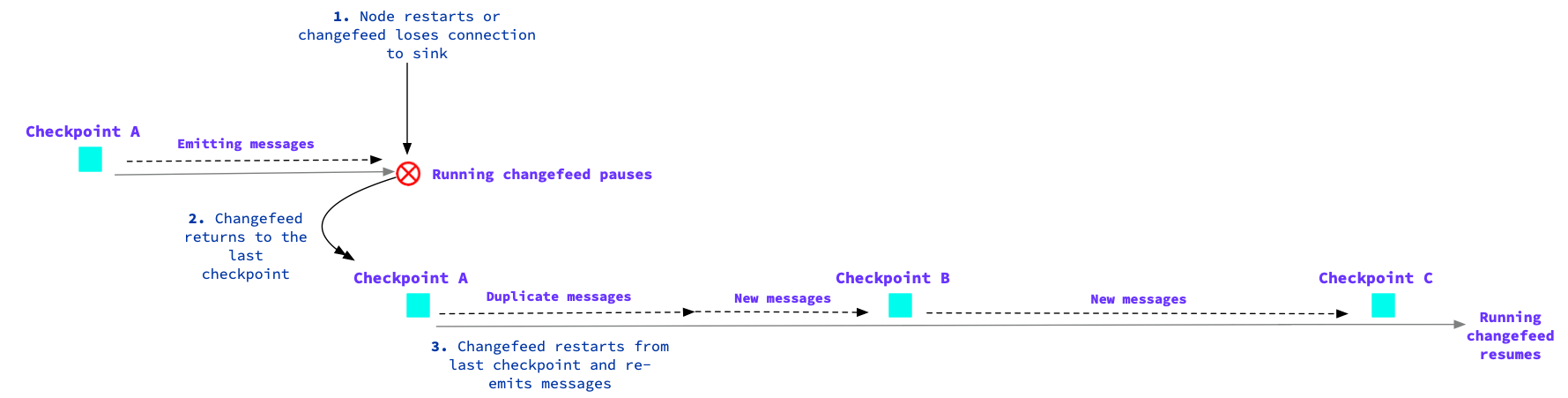
A changefeed job cannot confirm that a message has been received by the sink unless the changefeed has reached a checkpoint. As a changefeed job runs, each node will send checkpoint progress to the job's coordinator node. These progress reports allow the coordinator to update the high-water mark timestamp confirming that all changes before (or at) the timestamp have been emitted.
When a changefeed must pause and then resume, it will return to the last checkpoint (**A**), which is the last point at which the coordinator confirmed all changes for the given timestamp. As a result, when the changefeed resumes, it will re-emit the messages that were not confirmed in the next checkpoint. The changefeed may not re-emit every message, but it will ensure each change is emitted at least once.
 ### Changefeed encounters an error
By default, changefeeds treat errors as retryable except for some specific terminal errors. When a changefeed encounters a retryable or non-retryable error, the job will pause until a successful retry or you resume the job once the error is solved. This can cause duplicate messages at the sink as the changefeed returns to the last checkpoint.
We recommend monitoring for changefeed retry errors and failures. Refer to the Monitor and Debug Changefeeds page.
A sink's batching behavior can increase the number of duplicate messages. For example, if Kafka receives a batch of `N` messages and successfully saves `N-1` of them, the changefeed job only knows that the batch failed, not which message failed to commit. As a result, the changefeed job will resend the full batch of messages, which means all but one of the messages are duplicates. For Kafka sinks, reducing the batch size with `kafka_sink_config` may help to reduce the number of duplicate messages at the sink.
Refer to the Changefeed Sinks page for details on sink batching configuration.
### Node restarts
When a node restarts, the changefeed will emit duplicates since the last checkpoint. During a rolling restart of nodes, a changefeed can fall behind as it tries to catch up during each node restart. For example, as part of a rolling upgrade or cluster maintenance, a node may drain every 5 minutes and the changefeed job checkpoints every 5 minutes.
To prevent the changefeed from falling too far behind, pause changefeed jobs before performing rolling node restarts.
### `min_checkpoint_frequency` option
The `min_checkpoint_frequency` option controls how often nodes flush their progress to the coordinating changefeed node. Therefore, changefeeds will wait for at least the `min_checkpoint_frequency` duration before flushing to the sink. If a changefeed pauses and then resumes, the `min_checkpoint_frequency` duration is the amount of time that the changefeed will need to catch up since its previous checkpoint. During this catch-up time, you could receive duplicate messages.
## Schema Changes
For some schema changes, changefeeds will **not** emit duplicate records for the table that is being altered. Instead, the changefeed will only emit a copy of the table using the new schema. Refer to [Schema changes with column backfill](#schema-changes-with-column-backfill) for examples of this.
### Avro schema changes
To ensure that the Avro schemas that CockroachDB publishes will work with the schema compatibility rules used by the Confluent schema registry, CockroachDB emits all fields in Avro as nullable unions. This ensures that Avro and Confluent consider the schemas to be both backward- and forward-compatible, because the Confluent Schema Registry has a different set of rules than Avro for schemas to be backward- and forward-compatible.
The original CockroachDB column definition is also included within a doc field `__crdb__` in the schema. This allows CockroachDB to distinguish between a `NOT NULL` CockroachDB column and a `NULL` CockroachDB column.
Schema validation tools should ignore the `__crdb__` field. This is an internal CockroachDB schema type description that may change between CockroachDB versions.
### Schema changes with column backfill
When schema changes with column backfill (e.g., adding a column with a default, adding a stored computed column, adding a `NOT NULL` column, dropping a column) are made to watched rows, CockroachDB emits a copy of the table using the new schema.
The following example demonstrates the messages you will receive after creating a changefeed and then applying a schema change to the watched table:
```sql theme={"theme":{"light":"catppuccin-mocha","dark":"catppuccin-mocha"}}
CREATE TABLE office_dogs (
id INT PRIMARY KEY,
name STRING);
```
```sql theme={"theme":{"light":"catppuccin-mocha","dark":"catppuccin-mocha"}}
INSERT INTO office_dogs VALUES
(1, 'Petee H'),
(2, 'Carl'),
(3, 'Ernie');
```
```sql theme={"theme":{"light":"catppuccin-mocha","dark":"catppuccin-mocha"}}
CREATE CHANGEFEED FOR TABLE office_dogs INTO 'external://cloud';
```
You receive each of the rows at the sink:
```json theme={"theme":{"light":"catppuccin-mocha","dark":"catppuccin-mocha"}}
[1] {"id": 1, "name": "Petee H"}
[2] {"id": 2, "name": "Carl"}
[3] {"id": 3, "name": "Ernie"}
```
For example, add a column to the watched table:
```sql theme={"theme":{"light":"catppuccin-mocha","dark":"catppuccin-mocha"}}
ALTER TABLE office_dogs ADD COLUMN likes_treats BOOL DEFAULT TRUE;
```
After the schema change, the changefeed will emit a copy of the table with the new schema:
```json theme={"theme":{"light":"catppuccin-mocha","dark":"catppuccin-mocha"}}
[1] {"id": 1, "name": "Petee H"}
[2] {"id": 2, "name": "Carl"}
[3] {"id": 3, "name": "Ernie"}
[1] {"id": 1, "likes_treats": true, "name": "Petee H"}
[2] {"id": 2, "likes_treats": true, "name": "Carl"}
[3] {"id": 3, "likes_treats": true, "name": "Ernie"}
```
For some schema changes, the changefeed will emit a copy of the altered table and a copy of the table using the new schema:
```json theme={"theme":{"light":"catppuccin-mocha","dark":"catppuccin-mocha"}}
[1] {"id": 1, "name": "Petee H"}
[2] {"id": 2, "name": "Carl"}
[3] {"id": 3, "name": "Ernie"}
[1] {"id": 1, "name": "Petee H"} # Duplicate
[2] {"id": 2, "name": "Carl"} # Duplicate
[3] {"id": 3, "name": "Ernie"} # Duplicate
[1] {"id": 1, "likes_treats": true, "name": "Petee H"}
[2] {"id": 2, "likes_treats": true, "name": "Carl"}
[3] {"id": 3, "likes_treats": true, "name": "Ernie"}
```
To prevent the changefeed from emitting a copy of the table with the new schema, use the `schema_change_policy = nobackfill` option. In the preceding two output blocks, the new schema messages that include the `"likes_treats"` column will not emit.
Refer to the `CREATE CHANGEFEED` option table for detail on the `schema_change_policy` option. You can also use the `schema_change_events` option to define the type of schema change event that triggers the behavior specified in `schema_change_policy`.
As of v22.1, changefeeds filter out `VIRTUAL` computed columns from events by default. This is a backward-incompatible change. To maintain the changefeed behavior in previous versions where `NULL` values are emitted for virtual computed columns, see the `virtual_columns` option for more detail.
## Filtering changefeed messages
There are several ways to define messages, filter different types of message, or prevent all changefeed messages from emitting to the sink. The following sections outline configurable settings and SQL syntax to handle different use cases.
### Prevent changefeeds from emitting row-level TTL deletes
Use the `ttl_disable_changefeed_replication` table storage parameter to prevent changefeeds from sending `DELETE` messages issued by row-level TTL jobs for a table. Include the storage parameter when you create or alter the table. For example:
```sql theme={"theme":{"light":"catppuccin-mocha","dark":"catppuccin-mocha"}}
CREATE TABLE tbl (
id UUID PRIMARY KEY default gen_random_uuid(),
value TEXT
) WITH (ttl_expire_after = '3 weeks', ttl_job_cron = '@daily', ttl_disable_changefeed_replication = 'true');
```
```sql theme={"theme":{"light":"catppuccin-mocha","dark":"catppuccin-mocha"}}
ALTER TABLE events SET (ttl_expire_after = '1 year', ttl_disable_changefeed_replication = 'true');
```
You can also widen the scope to the cluster by setting the `sql.ttl.changefeed_replication.disabled` cluster setting to `true`. This will prevent changefeeds from emitting deletes issued by all TTL jobs on a cluster.
If you want to have a changefeed ignore the storage parameter or cluster setting that disables changefeed replication, you can set the changefeed option `ignore_disable_changefeed_replication` to `true`:
```sql theme={"theme":{"light":"catppuccin-mocha","dark":"catppuccin-mocha"}}
CREATE CHANGEFEED FOR TABLE table_name INTO 'external://changefeed-sink'
WITH resolved, ignore_disable_changefeed_replication = true;
```
This is useful when you have multiple use cases for different changefeeds on the same table. For example, you have a table with a changefeed streaming changes to another database for analytics workflows in which you do not want to reflect row-level TTL deletes. Secondly, you have a changefeed on the same table for audit-logging purposes for which you need to persist every change through the changefeed.
### Disable changefeeds from emitting messages
To prevent changefeeds from emitting messages for any changes (e.g., `INSERT`, `UPDATE`) issued to watched tables during that session, set the `disable_changefeed_replication` session variable to `true`.
### Define the change data emitted to a sink
When you create a changefeed, use change data capture queries to define the change data emitted to your sink.
For example:
```sql theme={"theme":{"light":"catppuccin-mocha","dark":"catppuccin-mocha"}}
CREATE CHANGEFEED INTO 'scheme://sink-URI' WITH updated AS SELECT column, column FROM table;
```
For details on syntax and examples, refer to the Change Data Capture Queries page.
## Message formats
By default, changefeeds emit messages in JSON format. You can use a different format by creating a changefeed with the `format` option and specifying one of the following:
* `json`
* `csv`
* `avro`
* `parquet`
Changefeed types are not fully integrated with user-defined composite types. Running changefeeds with user-defined composite types is in Preview. Certain changefeed types do not support user-defined composite types. Refer to the change data capture Known Limitations for more detail.
The following sections outline the limitations and type mapping for relevant formats.
### Avro
The following sections provide information on Avro usage with CockroachDB changefeeds. Creating a changefeed using Avro is available with the `confluent_schema_registry` option.
#### Avro limitations
Below are clarifications for particular SQL types and values for Avro changefeeds:
* Decimals must have precision specified.
* `BYTES` (or its aliases `BYTEA` and `BLOB`) are often used to store machine-readable data. When you stream these types through a changefeed with `format=avro`, CockroachDB does not encode or change the data. However, Avro clients can often include escape sequences to present the data in a printable format, which can interfere with deserialization. A potential solution is to hex-encode `BYTES` values when initially inserting them into CockroachDB. This will ensure that Avro clients can consistently decode the hexadecimal. Note that hex-encoding values at insertion will increase record size.
* `BIT` and `VARBIT` types are encoded as arrays of 64-bit integers.
For efficiency, CockroachDB encodes `BIT` and `VARBIT` bitfield types as arrays of 64-bit integers. That is, [base-2 (binary format)](https://wikipedia.org/wiki/Binary_number#Conversion_to_and_from_other_numeral_systems) `BIT` and `VARBIT` data types are converted to base 10 and stored in arrays. Encoding in CockroachDB is [big-endian](https://wikipedia.org/wiki/Endianness), therefore the last value may have many trailing zeroes. For this reason, the first value of each array is the number of bits that are used in the last value of the array.
For instance, if the bitfield is 129 bits long, there will be 4 integers in the array. The first integer will be `1`; representing the number of bits in the last value, the second integer will be the first 64 bits, the third integer will be bits 65–128, and the last integer will either be `0` or `9223372036854775808` (i.e., the integer with only the first bit set, or `1000000000000000000000000000000000000000000000000000000000000000` when base 2).
This example is base-10 encoded into an array as follows:
```
{"array": [1, , , 0 or 9223372036854775808]}
```
For downstream processing, it is necessary to base-2 encode every element in the array (except for the first element). The first number in the array gives you the number of bits to take from the last base-2 number — that is, the most significant bits. So, in the example above this would be `1`. Finally, all the base-2 numbers can be appended together, which will result in the original number of bits, 129.
In a different example of this process where the bitfield is 136 bits long, the array would be similar to the following when base-10 encoded:
```
{"array": [8, 18293058736425533439, 18446744073709551615, 13690942867206307840]}
```
To then work with this data, you would convert each of the elements in the array to base-2 numbers, besides the first element. For the above array, this would convert to:
```
[8, 1111110111011011111111111111111111111111111111111111111111111111, 1111111111111111111111111111111111111111111111111111111111111111, 1011111000000000000000000000000000000000000000000000000000000000]
```
Next, you use the first element in the array to take the number of bits from the last base-2 element, `10111110`. Finally, you append each of the base-2 numbers together — in the above array, the second, third, and truncated last element. This results in 136 bits, the original number of bits.
* A changefeed in Avro format will not be able to serialize user-defined composite (tuple) types.
#### Avro types
Below is a mapping of CockroachDB types to Avro types:
| CockroachDB Type | Avro Type | Avro Logical Type |
| ----------------------------------------------------------- | --------------------------------------------------------------------------------------------------------------------------------------------------- | ---------------------------------------------------------------------------------------------- |
| `ARRAY` | [`ARRAY`](https://avro.apache.org/docs/1.8.1/spec.html#schema_complex) | |
| `BIT` | Array of [`LONG`](https://avro.apache.org/docs/1.8.1/spec.html#schema_primitive) | |
| `BLOB` | [`BYTES`](https://avro.apache.org/docs/1.8.1/spec.html#schema_primitive) | |
| `BOOL` | [`BOOLEAN`](https://avro.apache.org/docs/1.8.1/spec.html#schema_primitive) | |
| `BYTEA` | [`BYTES`](https://avro.apache.org/docs/1.8.1/spec.html#schema_primitive) | |
| `BYTES` | [`BYTES`](https://avro.apache.org/docs/1.8.1/spec.html#schema_primitive) | |
| `COLLATE` | [`STRING`](https://avro.apache.org/docs/1.8.1/spec.html#schema_primitive) | |
| `DATE` | [`INT`](https://avro.apache.org/docs/1.8.1/spec.html#schema_primitive) | [`DATE`](https://avro.apache.org/docs/1.8.1/spec.html#Date) |
| `DECIMAL` | [`STRING`](https://avro.apache.org/docs/1.8.1/spec.html#schema_primitive), [`BYTES`](https://avro.apache.org/docs/1.8.1/spec.html#schema_primitive) | [`DECIMAL`](https://avro.apache.org/docs/1.8.1/spec.html#Decimal) |
| `ENUMS` | [`STRING`](https://avro.apache.org/docs/1.8.1/spec.html#schema_primitive) | |
| `FLOAT` | [`DOUBLE`](https://avro.apache.org/docs/1.8.1/spec.html#schema_primitive) | |
| `INET` | [`STRING`](https://avro.apache.org/docs/1.8.1/spec.html#schema_primitive) | |
| `INT` | [`LONG`](https://avro.apache.org/docs/1.8.1/spec.html#schema_primitive) | |
| `INTERVAL` | [`STRING`](https://avro.apache.org/docs/1.8.1/spec.html#schema_primitive) | |
| `JSONB` | [`STRING`](https://avro.apache.org/docs/1.8.1/spec.html#schema_primitive) | |
| `STRING` | [`STRING`](https://avro.apache.org/docs/1.8.1/spec.html#schema_primitive) | |
| `TIME` | [`LONG`](https://avro.apache.org/docs/1.8.1/spec.html#schema_primitive) | [`TIME-MICROS`](https://avro.apache.org/docs/1.8.1/spec.html#Time+%28microsecond+precision%29) |
| `TIMESTAMP` | [`LONG`](https://avro.apache.org/docs/1.8.1/spec.html#schema_primitive) | [`TIME-MICROS`](https://avro.apache.org/docs/1.8.1/spec.html#Time+%28microsecond+precision%29) |
| `TIMESTAMPTZ` | [`LONG`](https://avro.apache.org/docs/1.8.1/spec.html#schema_primitive) | [`TIME-MICROS`](https://avro.apache.org/docs/1.8.1/spec.html#Time+%28microsecond+precision%29) |
| `UUID` | [`STRING`](https://avro.apache.org/docs/1.8.1/spec.html#schema_primitive) | |
| `VARBIT` | Array of [`LONG`](https://avro.apache.org/docs/1.8.1/spec.html#schema_primitive) | |
The `DECIMAL` type is a union between Avro `STRING` and Avro `DECIMAL` types.
### CSV
You can use the `format=csv` option to emit CSV format messages from your changefeed. However, there are the following limitations with this option:
* It **only** works in combination with the `initial_scan = 'only'` option.
* It does **not** work when used with the `diff` or `resolved` options.
* A changefeed emitting CSV will include `AS` labels in the message format when the changefeed serializes a user-defined composite type.
Changefeeds emit the same CSV format as `EXPORT`. In v22.1, changefeeds emitted CSV data that wrapped some values in single quotes, which were not wrapped when exporting data with the `EXPORT` statement.
See Export Data with Changefeeds for detail on using changefeeds to export data from CockroachDB.
The following shows example CSV format output:
```
4ccccccc-cccc-4c00-8000-00000000000f,washington dc,Holly Williams,95153 Harvey Street Suite 5,2165526885
51eb851e-b851-4c00-8000-000000000010,washington dc,Ryan Hickman,21187 Dennis Village,1635328127
56242e0e-4935-4d21-a8cd-915f4002e53c,washington dc,Joshua Smith,80842 Edwards Bridge,1892482054
5707febd-0278-4e55-8715-adbb35f09759,washington dc,Preston Fisher,5603 David Mission Apt. 93,5802323725
576546de-d59c-429b-9251-be79472643d4,washington dc,Anna Underwood,81246 Lee Knoll,2838348371
596c1cf8-d59f-4ad6-9379-6aba82648ca9,washington dc,Gerald Good,59876 Wang Neck,6779715200
5d30f838-e24c-46cb-bb0c-4a5643ddc2b1,washington dc,Lawrence Lucas,67248 Robinson Way Apt. 46,6167017463
65c398b9-7cce-45c5-9a5b-9561569ae030,washington dc,Mr. Xavier Waters,85393 Diaz Camp,1783482816
7a78fb0b-d368-46f6-b530-f9c74c19ba25,washington dc,Christopher Owens,7460 Curtis Centers,1470959770
80696ab6-7ec9-4e55-afee-4f468478fe82,washington dc,Patricia Gibson,77436 Vaughn Ville,3271633253
93750763-f992-4018-8a11-bf15ebfecc06,washington dc,Alison Romero,15878 Grant Forks Suite 16,2742488244
9cc3f995-0a91-4612-a079-e81ca28257ab,washington dc,Corey Dunn,15958 Jenna Locks,2358457606
9efd7047-c5e5-4501-9fcd-cff2d27efc34,washington dc,Patricia Gray,16139 Nicholas Wells Suite 64,8935020269
a253a15c-8e0a-4d25-aa87-1a0839935005,washington dc,Samantha Lee,90429 Russell Coves,2990967825
a3081762-9841-4275-ad7a-75a7e8d5f69d,washington dc,Preston Fisher,5603 David Mission Apt. 93,5802323725
aebb80a6-eceb-4d10-9d9a-f26270188114,washington dc,Kenneth Miller,52393 Stephen Mill Apt. 7,3966083325
```
### JSON
To distinguish between JSON `NULL` values and SQL `NULL` values in changefeed messages, you can use the `encode_json_value_null_as_object` option with `CREATE CHANGEFEED`. When you enable `encode_json_value_null_as_object`, JSON `NULL` values will emit as `{"__crdb_json_null__": true}`.
For example, the following `test` table has a primary key column and a `JSONB` column. The `INSERT` adds `NULL` values in each column. A changefeed without the option enabled will not distinguish between the SQL and JSON `NULL` values. With the `encode_json_value_null_as_object` option enabled, the changefeed emits the JSON `NULL` as `{"__crdb_json_null__": true}`:
```sql theme={"theme":{"light":"catppuccin-mocha","dark":"catppuccin-mocha"}}
CREATE TABLE test (id INT PRIMARY KEY, data JSONB);
```
```sql theme={"theme":{"light":"catppuccin-mocha","dark":"catppuccin-mocha"}}
INSERT INTO test VALUES (1, NULL), (2, 'null'::JSONB);
```
```sql theme={"theme":{"light":"catppuccin-mocha","dark":"catppuccin-mocha"}}
CREATE CHANGEFEED FOR TABLE test INTO 'external://sink';
```
Without the option enabled, it is not possible to distinguish the SQL and JSON `NULL` values in the emitted changefeed messages:
```
{"after": {"data": null, "id": 1}, "key": [1]}
{"after": {"data": null, "id": 2}, "key": [2]}
```
```sql theme={"theme":{"light":"catppuccin-mocha","dark":"catppuccin-mocha"}}
CREATE CHANGEFEED FOR TABLE test INTO 'external://sink' WITH encode_json_value_null_as_object;
```
With `encode_json_value_null_as_object` enabled, the changefeed will encode the JSON `NULL` value in the emitted messages:
```
{"after": {"data": null, "id": 1}, "key": [1]}
{"after": {"data": {"__crdb_json_null__": true}, "id": 2}, "key": [2]}
```
When `encode_json_value_null_as_object` is enabled, if the changefeed encounters the literal value `{"__crdb_json_null__": true}` in JSON, it will have the same representation as a JSON `NULL` value and a warning will be printed to the `DEV` logging channel.
## See also
* Online Schema Changes
* Change Data Capture Overview
* Create and Configure Changefeeds
### Changefeed encounters an error
By default, changefeeds treat errors as retryable except for some specific terminal errors. When a changefeed encounters a retryable or non-retryable error, the job will pause until a successful retry or you resume the job once the error is solved. This can cause duplicate messages at the sink as the changefeed returns to the last checkpoint.
We recommend monitoring for changefeed retry errors and failures. Refer to the Monitor and Debug Changefeeds page.
A sink's batching behavior can increase the number of duplicate messages. For example, if Kafka receives a batch of `N` messages and successfully saves `N-1` of them, the changefeed job only knows that the batch failed, not which message failed to commit. As a result, the changefeed job will resend the full batch of messages, which means all but one of the messages are duplicates. For Kafka sinks, reducing the batch size with `kafka_sink_config` may help to reduce the number of duplicate messages at the sink.
Refer to the Changefeed Sinks page for details on sink batching configuration.
### Node restarts
When a node restarts, the changefeed will emit duplicates since the last checkpoint. During a rolling restart of nodes, a changefeed can fall behind as it tries to catch up during each node restart. For example, as part of a rolling upgrade or cluster maintenance, a node may drain every 5 minutes and the changefeed job checkpoints every 5 minutes.
To prevent the changefeed from falling too far behind, pause changefeed jobs before performing rolling node restarts.
### `min_checkpoint_frequency` option
The `min_checkpoint_frequency` option controls how often nodes flush their progress to the coordinating changefeed node. Therefore, changefeeds will wait for at least the `min_checkpoint_frequency` duration before flushing to the sink. If a changefeed pauses and then resumes, the `min_checkpoint_frequency` duration is the amount of time that the changefeed will need to catch up since its previous checkpoint. During this catch-up time, you could receive duplicate messages.
## Schema Changes
For some schema changes, changefeeds will **not** emit duplicate records for the table that is being altered. Instead, the changefeed will only emit a copy of the table using the new schema. Refer to [Schema changes with column backfill](#schema-changes-with-column-backfill) for examples of this.
### Avro schema changes
To ensure that the Avro schemas that CockroachDB publishes will work with the schema compatibility rules used by the Confluent schema registry, CockroachDB emits all fields in Avro as nullable unions. This ensures that Avro and Confluent consider the schemas to be both backward- and forward-compatible, because the Confluent Schema Registry has a different set of rules than Avro for schemas to be backward- and forward-compatible.
The original CockroachDB column definition is also included within a doc field `__crdb__` in the schema. This allows CockroachDB to distinguish between a `NOT NULL` CockroachDB column and a `NULL` CockroachDB column.
Schema validation tools should ignore the `__crdb__` field. This is an internal CockroachDB schema type description that may change between CockroachDB versions.
### Schema changes with column backfill
When schema changes with column backfill (e.g., adding a column with a default, adding a stored computed column, adding a `NOT NULL` column, dropping a column) are made to watched rows, CockroachDB emits a copy of the table using the new schema.
The following example demonstrates the messages you will receive after creating a changefeed and then applying a schema change to the watched table:
```sql theme={"theme":{"light":"catppuccin-mocha","dark":"catppuccin-mocha"}}
CREATE TABLE office_dogs (
id INT PRIMARY KEY,
name STRING);
```
```sql theme={"theme":{"light":"catppuccin-mocha","dark":"catppuccin-mocha"}}
INSERT INTO office_dogs VALUES
(1, 'Petee H'),
(2, 'Carl'),
(3, 'Ernie');
```
```sql theme={"theme":{"light":"catppuccin-mocha","dark":"catppuccin-mocha"}}
CREATE CHANGEFEED FOR TABLE office_dogs INTO 'external://cloud';
```
You receive each of the rows at the sink:
```json theme={"theme":{"light":"catppuccin-mocha","dark":"catppuccin-mocha"}}
[1] {"id": 1, "name": "Petee H"}
[2] {"id": 2, "name": "Carl"}
[3] {"id": 3, "name": "Ernie"}
```
For example, add a column to the watched table:
```sql theme={"theme":{"light":"catppuccin-mocha","dark":"catppuccin-mocha"}}
ALTER TABLE office_dogs ADD COLUMN likes_treats BOOL DEFAULT TRUE;
```
After the schema change, the changefeed will emit a copy of the table with the new schema:
```json theme={"theme":{"light":"catppuccin-mocha","dark":"catppuccin-mocha"}}
[1] {"id": 1, "name": "Petee H"}
[2] {"id": 2, "name": "Carl"}
[3] {"id": 3, "name": "Ernie"}
[1] {"id": 1, "likes_treats": true, "name": "Petee H"}
[2] {"id": 2, "likes_treats": true, "name": "Carl"}
[3] {"id": 3, "likes_treats": true, "name": "Ernie"}
```
For some schema changes, the changefeed will emit a copy of the altered table and a copy of the table using the new schema:
```json theme={"theme":{"light":"catppuccin-mocha","dark":"catppuccin-mocha"}}
[1] {"id": 1, "name": "Petee H"}
[2] {"id": 2, "name": "Carl"}
[3] {"id": 3, "name": "Ernie"}
[1] {"id": 1, "name": "Petee H"} # Duplicate
[2] {"id": 2, "name": "Carl"} # Duplicate
[3] {"id": 3, "name": "Ernie"} # Duplicate
[1] {"id": 1, "likes_treats": true, "name": "Petee H"}
[2] {"id": 2, "likes_treats": true, "name": "Carl"}
[3] {"id": 3, "likes_treats": true, "name": "Ernie"}
```
To prevent the changefeed from emitting a copy of the table with the new schema, use the `schema_change_policy = nobackfill` option. In the preceding two output blocks, the new schema messages that include the `"likes_treats"` column will not emit.
Refer to the `CREATE CHANGEFEED` option table for detail on the `schema_change_policy` option. You can also use the `schema_change_events` option to define the type of schema change event that triggers the behavior specified in `schema_change_policy`.
As of v22.1, changefeeds filter out `VIRTUAL` computed columns from events by default. This is a backward-incompatible change. To maintain the changefeed behavior in previous versions where `NULL` values are emitted for virtual computed columns, see the `virtual_columns` option for more detail.
## Filtering changefeed messages
There are several ways to define messages, filter different types of message, or prevent all changefeed messages from emitting to the sink. The following sections outline configurable settings and SQL syntax to handle different use cases.
### Prevent changefeeds from emitting row-level TTL deletes
Use the `ttl_disable_changefeed_replication` table storage parameter to prevent changefeeds from sending `DELETE` messages issued by row-level TTL jobs for a table. Include the storage parameter when you create or alter the table. For example:
```sql theme={"theme":{"light":"catppuccin-mocha","dark":"catppuccin-mocha"}}
CREATE TABLE tbl (
id UUID PRIMARY KEY default gen_random_uuid(),
value TEXT
) WITH (ttl_expire_after = '3 weeks', ttl_job_cron = '@daily', ttl_disable_changefeed_replication = 'true');
```
```sql theme={"theme":{"light":"catppuccin-mocha","dark":"catppuccin-mocha"}}
ALTER TABLE events SET (ttl_expire_after = '1 year', ttl_disable_changefeed_replication = 'true');
```
You can also widen the scope to the cluster by setting the `sql.ttl.changefeed_replication.disabled` cluster setting to `true`. This will prevent changefeeds from emitting deletes issued by all TTL jobs on a cluster.
If you want to have a changefeed ignore the storage parameter or cluster setting that disables changefeed replication, you can set the changefeed option `ignore_disable_changefeed_replication` to `true`:
```sql theme={"theme":{"light":"catppuccin-mocha","dark":"catppuccin-mocha"}}
CREATE CHANGEFEED FOR TABLE table_name INTO 'external://changefeed-sink'
WITH resolved, ignore_disable_changefeed_replication = true;
```
This is useful when you have multiple use cases for different changefeeds on the same table. For example, you have a table with a changefeed streaming changes to another database for analytics workflows in which you do not want to reflect row-level TTL deletes. Secondly, you have a changefeed on the same table for audit-logging purposes for which you need to persist every change through the changefeed.
### Disable changefeeds from emitting messages
To prevent changefeeds from emitting messages for any changes (e.g., `INSERT`, `UPDATE`) issued to watched tables during that session, set the `disable_changefeed_replication` session variable to `true`.
### Define the change data emitted to a sink
When you create a changefeed, use change data capture queries to define the change data emitted to your sink.
For example:
```sql theme={"theme":{"light":"catppuccin-mocha","dark":"catppuccin-mocha"}}
CREATE CHANGEFEED INTO 'scheme://sink-URI' WITH updated AS SELECT column, column FROM table;
```
For details on syntax and examples, refer to the Change Data Capture Queries page.
## Message formats
By default, changefeeds emit messages in JSON format. You can use a different format by creating a changefeed with the `format` option and specifying one of the following:
* `json`
* `csv`
* `avro`
* `parquet`
Changefeed types are not fully integrated with user-defined composite types. Running changefeeds with user-defined composite types is in Preview. Certain changefeed types do not support user-defined composite types. Refer to the change data capture Known Limitations for more detail.
The following sections outline the limitations and type mapping for relevant formats.
### Avro
The following sections provide information on Avro usage with CockroachDB changefeeds. Creating a changefeed using Avro is available with the `confluent_schema_registry` option.
#### Avro limitations
Below are clarifications for particular SQL types and values for Avro changefeeds:
* Decimals must have precision specified.
* `BYTES` (or its aliases `BYTEA` and `BLOB`) are often used to store machine-readable data. When you stream these types through a changefeed with `format=avro`, CockroachDB does not encode or change the data. However, Avro clients can often include escape sequences to present the data in a printable format, which can interfere with deserialization. A potential solution is to hex-encode `BYTES` values when initially inserting them into CockroachDB. This will ensure that Avro clients can consistently decode the hexadecimal. Note that hex-encoding values at insertion will increase record size.
* `BIT` and `VARBIT` types are encoded as arrays of 64-bit integers.
For efficiency, CockroachDB encodes `BIT` and `VARBIT` bitfield types as arrays of 64-bit integers. That is, [base-2 (binary format)](https://wikipedia.org/wiki/Binary_number#Conversion_to_and_from_other_numeral_systems) `BIT` and `VARBIT` data types are converted to base 10 and stored in arrays. Encoding in CockroachDB is [big-endian](https://wikipedia.org/wiki/Endianness), therefore the last value may have many trailing zeroes. For this reason, the first value of each array is the number of bits that are used in the last value of the array.
For instance, if the bitfield is 129 bits long, there will be 4 integers in the array. The first integer will be `1`; representing the number of bits in the last value, the second integer will be the first 64 bits, the third integer will be bits 65–128, and the last integer will either be `0` or `9223372036854775808` (i.e., the integer with only the first bit set, or `1000000000000000000000000000000000000000000000000000000000000000` when base 2).
This example is base-10 encoded into an array as follows:
```
{"array": [1, , , 0 or 9223372036854775808]}
```
For downstream processing, it is necessary to base-2 encode every element in the array (except for the first element). The first number in the array gives you the number of bits to take from the last base-2 number — that is, the most significant bits. So, in the example above this would be `1`. Finally, all the base-2 numbers can be appended together, which will result in the original number of bits, 129.
In a different example of this process where the bitfield is 136 bits long, the array would be similar to the following when base-10 encoded:
```
{"array": [8, 18293058736425533439, 18446744073709551615, 13690942867206307840]}
```
To then work with this data, you would convert each of the elements in the array to base-2 numbers, besides the first element. For the above array, this would convert to:
```
[8, 1111110111011011111111111111111111111111111111111111111111111111, 1111111111111111111111111111111111111111111111111111111111111111, 1011111000000000000000000000000000000000000000000000000000000000]
```
Next, you use the first element in the array to take the number of bits from the last base-2 element, `10111110`. Finally, you append each of the base-2 numbers together — in the above array, the second, third, and truncated last element. This results in 136 bits, the original number of bits.
* A changefeed in Avro format will not be able to serialize user-defined composite (tuple) types.
#### Avro types
Below is a mapping of CockroachDB types to Avro types:
| CockroachDB Type | Avro Type | Avro Logical Type |
| ----------------------------------------------------------- | --------------------------------------------------------------------------------------------------------------------------------------------------- | ---------------------------------------------------------------------------------------------- |
| `ARRAY` | [`ARRAY`](https://avro.apache.org/docs/1.8.1/spec.html#schema_complex) | |
| `BIT` | Array of [`LONG`](https://avro.apache.org/docs/1.8.1/spec.html#schema_primitive) | |
| `BLOB` | [`BYTES`](https://avro.apache.org/docs/1.8.1/spec.html#schema_primitive) | |
| `BOOL` | [`BOOLEAN`](https://avro.apache.org/docs/1.8.1/spec.html#schema_primitive) | |
| `BYTEA` | [`BYTES`](https://avro.apache.org/docs/1.8.1/spec.html#schema_primitive) | |
| `BYTES` | [`BYTES`](https://avro.apache.org/docs/1.8.1/spec.html#schema_primitive) | |
| `COLLATE` | [`STRING`](https://avro.apache.org/docs/1.8.1/spec.html#schema_primitive) | |
| `DATE` | [`INT`](https://avro.apache.org/docs/1.8.1/spec.html#schema_primitive) | [`DATE`](https://avro.apache.org/docs/1.8.1/spec.html#Date) |
| `DECIMAL` | [`STRING`](https://avro.apache.org/docs/1.8.1/spec.html#schema_primitive), [`BYTES`](https://avro.apache.org/docs/1.8.1/spec.html#schema_primitive) | [`DECIMAL`](https://avro.apache.org/docs/1.8.1/spec.html#Decimal) |
| `ENUMS` | [`STRING`](https://avro.apache.org/docs/1.8.1/spec.html#schema_primitive) | |
| `FLOAT` | [`DOUBLE`](https://avro.apache.org/docs/1.8.1/spec.html#schema_primitive) | |
| `INET` | [`STRING`](https://avro.apache.org/docs/1.8.1/spec.html#schema_primitive) | |
| `INT` | [`LONG`](https://avro.apache.org/docs/1.8.1/spec.html#schema_primitive) | |
| `INTERVAL` | [`STRING`](https://avro.apache.org/docs/1.8.1/spec.html#schema_primitive) | |
| `JSONB` | [`STRING`](https://avro.apache.org/docs/1.8.1/spec.html#schema_primitive) | |
| `STRING` | [`STRING`](https://avro.apache.org/docs/1.8.1/spec.html#schema_primitive) | |
| `TIME` | [`LONG`](https://avro.apache.org/docs/1.8.1/spec.html#schema_primitive) | [`TIME-MICROS`](https://avro.apache.org/docs/1.8.1/spec.html#Time+%28microsecond+precision%29) |
| `TIMESTAMP` | [`LONG`](https://avro.apache.org/docs/1.8.1/spec.html#schema_primitive) | [`TIME-MICROS`](https://avro.apache.org/docs/1.8.1/spec.html#Time+%28microsecond+precision%29) |
| `TIMESTAMPTZ` | [`LONG`](https://avro.apache.org/docs/1.8.1/spec.html#schema_primitive) | [`TIME-MICROS`](https://avro.apache.org/docs/1.8.1/spec.html#Time+%28microsecond+precision%29) |
| `UUID` | [`STRING`](https://avro.apache.org/docs/1.8.1/spec.html#schema_primitive) | |
| `VARBIT` | Array of [`LONG`](https://avro.apache.org/docs/1.8.1/spec.html#schema_primitive) | |
The `DECIMAL` type is a union between Avro `STRING` and Avro `DECIMAL` types.
### CSV
You can use the `format=csv` option to emit CSV format messages from your changefeed. However, there are the following limitations with this option:
* It **only** works in combination with the `initial_scan = 'only'` option.
* It does **not** work when used with the `diff` or `resolved` options.
* A changefeed emitting CSV will include `AS` labels in the message format when the changefeed serializes a user-defined composite type.
Changefeeds emit the same CSV format as `EXPORT`. In v22.1, changefeeds emitted CSV data that wrapped some values in single quotes, which were not wrapped when exporting data with the `EXPORT` statement.
See Export Data with Changefeeds for detail on using changefeeds to export data from CockroachDB.
The following shows example CSV format output:
```
4ccccccc-cccc-4c00-8000-00000000000f,washington dc,Holly Williams,95153 Harvey Street Suite 5,2165526885
51eb851e-b851-4c00-8000-000000000010,washington dc,Ryan Hickman,21187 Dennis Village,1635328127
56242e0e-4935-4d21-a8cd-915f4002e53c,washington dc,Joshua Smith,80842 Edwards Bridge,1892482054
5707febd-0278-4e55-8715-adbb35f09759,washington dc,Preston Fisher,5603 David Mission Apt. 93,5802323725
576546de-d59c-429b-9251-be79472643d4,washington dc,Anna Underwood,81246 Lee Knoll,2838348371
596c1cf8-d59f-4ad6-9379-6aba82648ca9,washington dc,Gerald Good,59876 Wang Neck,6779715200
5d30f838-e24c-46cb-bb0c-4a5643ddc2b1,washington dc,Lawrence Lucas,67248 Robinson Way Apt. 46,6167017463
65c398b9-7cce-45c5-9a5b-9561569ae030,washington dc,Mr. Xavier Waters,85393 Diaz Camp,1783482816
7a78fb0b-d368-46f6-b530-f9c74c19ba25,washington dc,Christopher Owens,7460 Curtis Centers,1470959770
80696ab6-7ec9-4e55-afee-4f468478fe82,washington dc,Patricia Gibson,77436 Vaughn Ville,3271633253
93750763-f992-4018-8a11-bf15ebfecc06,washington dc,Alison Romero,15878 Grant Forks Suite 16,2742488244
9cc3f995-0a91-4612-a079-e81ca28257ab,washington dc,Corey Dunn,15958 Jenna Locks,2358457606
9efd7047-c5e5-4501-9fcd-cff2d27efc34,washington dc,Patricia Gray,16139 Nicholas Wells Suite 64,8935020269
a253a15c-8e0a-4d25-aa87-1a0839935005,washington dc,Samantha Lee,90429 Russell Coves,2990967825
a3081762-9841-4275-ad7a-75a7e8d5f69d,washington dc,Preston Fisher,5603 David Mission Apt. 93,5802323725
aebb80a6-eceb-4d10-9d9a-f26270188114,washington dc,Kenneth Miller,52393 Stephen Mill Apt. 7,3966083325
```
### JSON
To distinguish between JSON `NULL` values and SQL `NULL` values in changefeed messages, you can use the `encode_json_value_null_as_object` option with `CREATE CHANGEFEED`. When you enable `encode_json_value_null_as_object`, JSON `NULL` values will emit as `{"__crdb_json_null__": true}`.
For example, the following `test` table has a primary key column and a `JSONB` column. The `INSERT` adds `NULL` values in each column. A changefeed without the option enabled will not distinguish between the SQL and JSON `NULL` values. With the `encode_json_value_null_as_object` option enabled, the changefeed emits the JSON `NULL` as `{"__crdb_json_null__": true}`:
```sql theme={"theme":{"light":"catppuccin-mocha","dark":"catppuccin-mocha"}}
CREATE TABLE test (id INT PRIMARY KEY, data JSONB);
```
```sql theme={"theme":{"light":"catppuccin-mocha","dark":"catppuccin-mocha"}}
INSERT INTO test VALUES (1, NULL), (2, 'null'::JSONB);
```
```sql theme={"theme":{"light":"catppuccin-mocha","dark":"catppuccin-mocha"}}
CREATE CHANGEFEED FOR TABLE test INTO 'external://sink';
```
Without the option enabled, it is not possible to distinguish the SQL and JSON `NULL` values in the emitted changefeed messages:
```
{"after": {"data": null, "id": 1}, "key": [1]}
{"after": {"data": null, "id": 2}, "key": [2]}
```
```sql theme={"theme":{"light":"catppuccin-mocha","dark":"catppuccin-mocha"}}
CREATE CHANGEFEED FOR TABLE test INTO 'external://sink' WITH encode_json_value_null_as_object;
```
With `encode_json_value_null_as_object` enabled, the changefeed will encode the JSON `NULL` value in the emitted messages:
```
{"after": {"data": null, "id": 1}, "key": [1]}
{"after": {"data": {"__crdb_json_null__": true}, "id": 2}, "key": [2]}
```
When `encode_json_value_null_as_object` is enabled, if the changefeed encounters the literal value `{"__crdb_json_null__": true}` in JSON, it will have the same representation as a JSON `NULL` value and a warning will be printed to the `DEV` logging channel.
## See also
* Online Schema Changes
* Change Data Capture Overview
* Create and Configure Changefeeds