> ## Documentation Index
> Fetch the complete documentation index at: https://cockroachlabs.mintlify.site/llms.txt
> Use this file to discover all available pages before exploring further.
# Disaster Recovery Overview
export const InternalLink = ({version, path = "", children, ...props}) => {
let detectedVersion = version || "stable";
if (typeof window !== 'undefined' && !version) {
const match = window.location.pathname.match(/\/docs\/([^/]+)/);
if (match) {
detectedVersion = match[1];
}
}
const normalizedPath = path.startsWith("/") ? path.slice(1) : path;
return
{children}
;
};
Resilient deployments aim for continuity in database operations to protect from data loss and downtime. To maintain resiliency, it is necessary to build deployments with *high availability* and *disaster recovery* coverage.
* [High availability](#choose-a-high-availability-strategy): Continuously access data without interruption even in the presence of failures or disruptions to maximize uptime.
* [Disaster recovery](#choose-a-disaster-recovery-strategy): Recover from a major incident or disaster to minimize downtime and data loss.
To build resilient cluster deployments, CockroachDB provides both built-in replication for high availability and disaster recovery features for coverage during unplanned incidents.
For a practical guide on how CockroachDB replicates, distributes, and rebalances data, refer to the Replication and Rebalancing demo.
## Resilience strategy
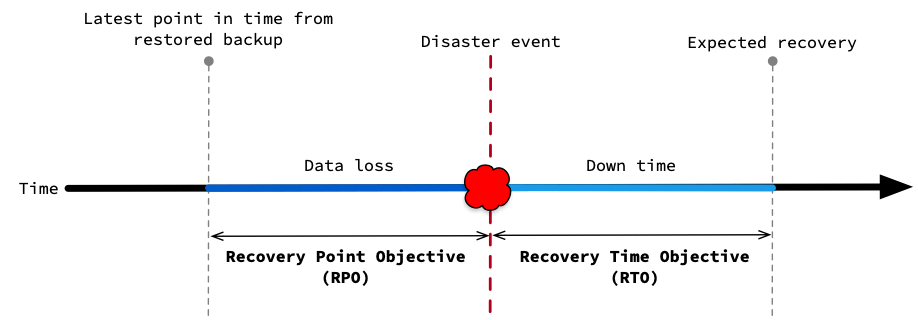
As you evaluate CockroachDB's disaster recovery features, consider your organization's requirements for the amount of tolerable data loss and the acceptable length of time to recover.
* Recovery Point Objective (RPO): The maximum amount of data loss (measured by time) that an organization can tolerate.
* Recovery Time Objective (RTO): The maximum length of time it should take to restore normal operations following an outage.
For example, when you use backups:
 For a comparison of CockroachDB resiliency features, refer to the following sections:
* [Choose a high availability strategy](#choose-a-high-availability-strategy)
* [Choose a disaster recovery strategy](#choose-a-disaster-recovery-strategy)
### Choose a high availability strategy
CockroachDB uses synchronous, built-in replication to create and distribute copies of data, ensuring consistency across the data copies. The database can tolerate nodes going offline without service interruption, whether in a single-region or multi-region cluster.
| | Single-region replication (synchronous) | Multi-region replication (synchronous) |
| ------------------- | ------------------------------------------------------------------------------------------- | ------------------------------------------------------------------------------------------------------------ |
| **RPO** | 0 seconds | 0 seconds |
| **RTO** | Zero RTO Potential increased latency for 1-9 seconds | Zero RTO Potential increased latency for 1-9 seconds |
| **Write latency** | Region-local write latency p50 latency \< 5ms (for multiple availability zones in us-east1) | Cross-region write latency p50 latency > 50ms (for a multi-region cluster in us-east1, us-east-2, us-west-1) |
| **Recovery** | Automatic | Automatic |
| **Hardware cost** | 1x Networking between availability zones | 1x Networking between datacenters |
| **Minimum regions** | 1 | 3 |
| **Fault tolerance** | Zero RPO node, availability zone failures | Zero RPO node, availability zone failures, region failures |
For details on designing your cluster topology for high availability with replication, refer to the Disaster Recovery Planning page.
### Choose a disaster recovery strategy
CockroachDB is designed to recover automatically; however, building backups or physical cluster replication into your disaster recovery planning is an important part of a resilient deployment.
| | Point in time backup & restore | Physical cluster replication (asynchronous) |
| ------------------- | ------------------------------------------------------------ | -------------------------------------------------------------------- |
| **RPO** | >=5 minutes | 10s of seconds |
| **RTO** | Minutes to hours, depending on data size and number of nodes | Seconds to minutes, depending on cluster size |
| **Write latency** | No impact | No impact |
| **Recovery** | Manual restore | Manual failover |
| **Hardware cost** | 1x + S3-like storage & networking | 2x + networking between datacenters |
| **Minimum regions** | 1 | 2 |
| **Fault tolerance** | Not applicable | Zero RPO node, availability zone, region failure with loss up to RPO |
For a comparison of CockroachDB resiliency features, refer to the following sections:
* [Choose a high availability strategy](#choose-a-high-availability-strategy)
* [Choose a disaster recovery strategy](#choose-a-disaster-recovery-strategy)
### Choose a high availability strategy
CockroachDB uses synchronous, built-in replication to create and distribute copies of data, ensuring consistency across the data copies. The database can tolerate nodes going offline without service interruption, whether in a single-region or multi-region cluster.
| | Single-region replication (synchronous) | Multi-region replication (synchronous) |
| ------------------- | ------------------------------------------------------------------------------------------- | ------------------------------------------------------------------------------------------------------------ |
| **RPO** | 0 seconds | 0 seconds |
| **RTO** | Zero RTO Potential increased latency for 1-9 seconds | Zero RTO Potential increased latency for 1-9 seconds |
| **Write latency** | Region-local write latency p50 latency \< 5ms (for multiple availability zones in us-east1) | Cross-region write latency p50 latency > 50ms (for a multi-region cluster in us-east1, us-east-2, us-west-1) |
| **Recovery** | Automatic | Automatic |
| **Hardware cost** | 1x Networking between availability zones | 1x Networking between datacenters |
| **Minimum regions** | 1 | 3 |
| **Fault tolerance** | Zero RPO node, availability zone failures | Zero RPO node, availability zone failures, region failures |
For details on designing your cluster topology for high availability with replication, refer to the Disaster Recovery Planning page.
### Choose a disaster recovery strategy
CockroachDB is designed to recover automatically; however, building backups or physical cluster replication into your disaster recovery planning is an important part of a resilient deployment.
| | Point in time backup & restore | Physical cluster replication (asynchronous) |
| ------------------- | ------------------------------------------------------------ | -------------------------------------------------------------------- |
| **RPO** | >=5 minutes | 10s of seconds |
| **RTO** | Minutes to hours, depending on data size and number of nodes | Seconds to minutes, depending on cluster size |
| **Write latency** | No impact | No impact |
| **Recovery** | Manual restore | Manual failover |
| **Hardware cost** | 1x + S3-like storage & networking | 2x + networking between datacenters |
| **Minimum regions** | 1 | 2 |
| **Fault tolerance** | Not applicable | Zero RPO node, availability zone, region failure with loss up to RPO |